


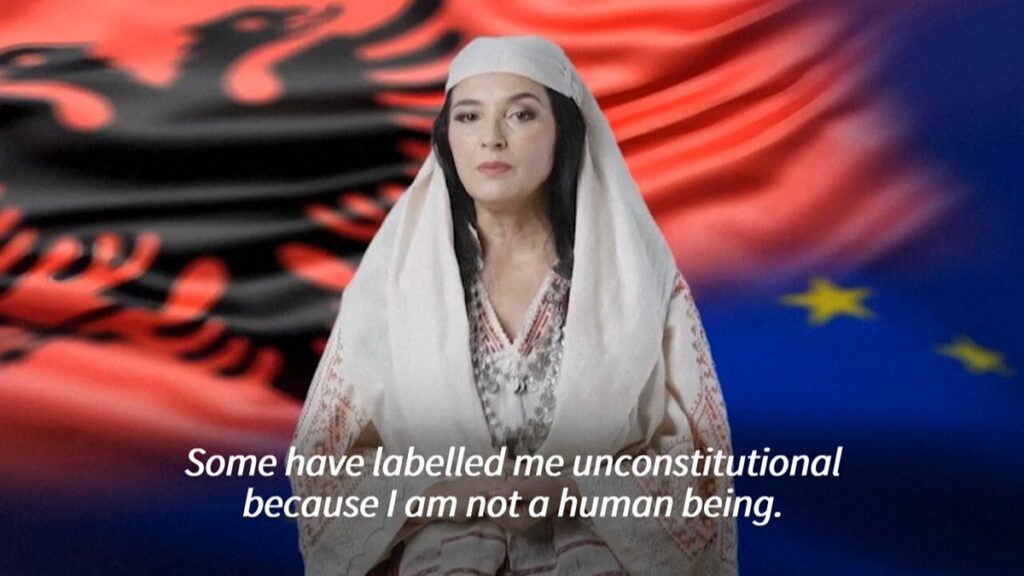
Last week Albania’s prime minister unveiled something straight out of the WEF playbook: an artificial-intelligence avatar named Diella installed as a cabinet-level “minister” in charge of public procurement.
The move — billed by Albanian government as a world-first effort to make contracting “100% free of corruption” — has left the world asking a different question: if an AI can be granted political authority over who gets government contracts, what else could it be used for down the line?
Prime Minister Edi Rama introduced Diella — an AI system already used as a virtual assistant on the state e-Albania portal — as the new Minister for Public Procurement, with the stated task of removing human bias and graft from tender decisions.
Diella made a short address to parliament asserting it was “not here to replace people” but to help ensure transparency.
“The Constitution speaks of institutions at the people’s service. It doesn’t speak of chromosomes, of flesh or blood,” the avatar declared in a three-minute address delivered from two large screens. “It speaks of duties, accountability, transparency, non-discriminatory service.”
“I assure you that I embody such values as strictly as every human colleague, maybe even more,” added the artificial persona. It has been named Diella, which means sun in Albanian, and is depicted as a woman in traditional Albanian dress.
For people who see a coordinated effort among global elites to centralize power, reduce populations, and enslave humanity, Diella looks less like a corruption-slayer and more like a test case — a precedent for handing crucial state functions to non-human systems that can be controlled, updated, and scaled without the messy accountability that comes with elected officials.
Going forward, the real questions are about control and expansion.
Will Albania release the actual code, decision logs, and criteria that Diella uses — or will everything stay hidden, giving the system’s handlers unchecked power?
Who is really behind the updates and training, and which tech firms are providing the cloud services that keep Diella running?
These companies are likely the true influence points. Another concern is “scope creep”: if Diella can manage tenders today, will it soon be tasked with health, welfare, or even national ID systems tomorrow?
Each new role would tighten the grip of centralized, algorithmic governance.
Finally, there is the issue of resistance — will courts or civil society demand constitutional limits, or will they allow an unelected AI minister to become a permanent fixture?
The answers to these questions will reveal how deeply this experiment is allowed to take root.