


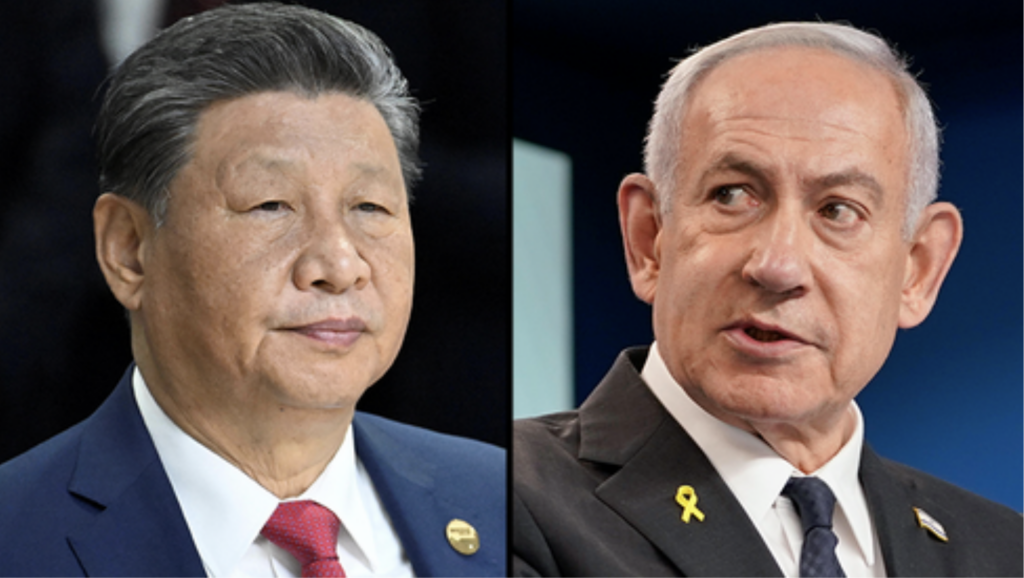
China is warning Benjamin Netanyahu directly: fire a nuclear weapon at Iran — or any other state — and Israel will not survive the consequences.
The warning came from Victor Gao Zhikai, Vice President of the Beijing-based Center for China and Globalization, in an interview with the World Clash Report. His words were not wrapped in the usual diplomatic hedging. “I want to tell the Israeli government and Israeli leaders,” Gao said, “the moment Israel uses a nuclear warhead against any other country, including Iran, it will be the demise of Israel as a country, as a state.”
Why This Warning Hits Different Right Now
In the ecosystem of Chinese strategic signaling, figures like Gao—a former translator for senior leaders and a frequent voice on global media panels—are often used to float ideas that official channels prefer to keep at arm’s length.
When someone with his profile says a nuclear strike would mean the “demise” of Israel, the message lands with more force than a boilerplate condemnation ever could.
And the context matters. In late October 2026, just days before Israeli elections, Prime Minister Benjamin Netanyahu posted an AI-generated image of a nuclear mushroom cloud rising over Tel Aviv, warning of a “second Holocaust” if voters chose anyone but him.
The post was met with fierce backlash inside Israel—opposition leader Gadi Eisenkot called Netanyahu “hysterical,” and Yair Golan demanded he be kept away from social media entirely . But internationally, the image did something else: it normalized, even flirted with, the unthinkable.
Gao’s warning is a direct answer to that flirtation.
The Logic of “Demise”
What makes Gao’s formulation striking is its precision. He did not say Israel would face “consequences” or “international isolation.” He said it would stop being a country. That framing shifts the debate from military tactics to existential math.
The reasoning is not mysterious. Israel’s security architecture rests on a tripod: military superiority, American political cover, and the nuclear ambiguity that has kept its adversaries guessing for decades. A nuclear first strike—against Iran or anyone else—would shatter all three at once. The United States would face overwhelming global pressure to cut ties.
The UN Security Council, where China holds a veto, would become a hostile arena rather than a shield. And the Arab states that have quietly moved toward normalization would scatter overnight.
Gao’s argument, in essence: the bomb Israel uses to destroy an enemy would destroy the diplomatic and political conditions that make Israel viable .
The Iranian Dimension
The warning specifically names Iran, and that is not incidental. Throughout 2026, Israel and the United States have conducted repeated strikes on Iranian nuclear facilities, including the Bushehr plant and sites near Natanz.
Iran has retaliated with ballistic missile strikes that demonstrated the ability to penetrate Israel’s air defense systems, hitting areas near the Dimona nuclear reactor and the Haifa oil refinery. The exchange has pushed the region closer to a threshold that has held since 1945.
Meanwhile, voices in the American commentariat have amplified the nuclear chatter. Tucker Carlson claimed in November that the Trump administration could be “days away” from a nuclear strike on Iran’s Pickaxe Mountain facility, alleging Netanyahu was pressing for it daily. Whether or not those claims are accurate, they feed a perception that the nuclear taboo is being stress-tested in real time.
What Beijing Actually Wants
China’s official position has been consistent: oppose military strikes on Iran, defend the nuclear non-proliferation regime, and warn that force “cannot truly solve problems”. Foreign Minister Wang Yi has told his Israeli counterpart directly that attacks on Iran “interrupted” diplomacy and must stop.
But Gao’s intervention goes further than official talking points. It frames nuclear use not as a violation of international law—though it would be—but as an act of national suicide. That is a message designed to penetrate the Israeli security establishment’s own logic. It speaks the language of survival, not morality.
For a Chinese policy circle increasingly positioning Beijing as a responsible stakeholder in Middle Eastern diplomacy, allowing this warning to circulate serves a purpose. It signals that China will not be a passive observer if the nuclear threshold is breached. And it puts Israel on notice.