


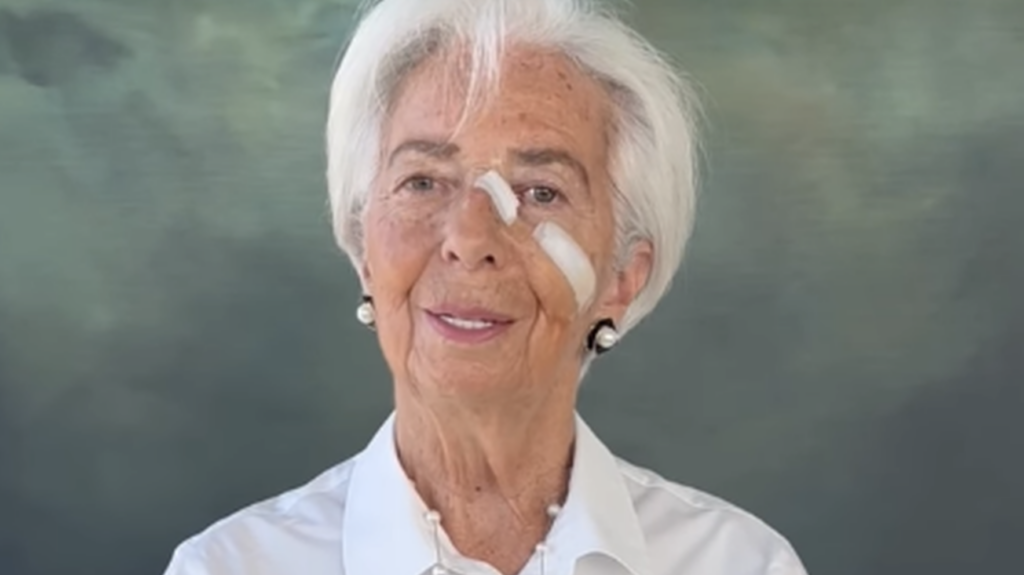
European Central Bank President Christine Lagarde appeared in a video statement looking as though she just lost an argument with a door frame, and abruptly announced she will step down months before her term was due to expire.
Lagarde, 70, said the bandages were the result of a “small surgery” earlier in the week. In a separate internal video to ECB staff, she joked that it was “not from kick-boxing in Thailand,” adding more intrigue to her sudden announcement.
The resignation announcement ends months of speculation about her future. Lagarde’s term was originally scheduled to run until the end of October 2027.
An official familiar with her thinking, speaking on condition of anonymity, said she chose to leave early to have “greater freedom to express her views and to engage in non-monetary matters, because she cannot remain neutral when she sees the developments taking place in her own country and in the world”.
At a press conference in Frankfurt, Lagarde said: “There is never a good time to leave,” explaining she wanted “the freedom of speech, the freedom of expression, and the freedom to engage on matters that are not monetary policy matters”.
The timing has drawn criticism. Markus Ferber, a German MEP from the center-right European People’s Party, said the early resignation sent “the wrong signal” given high inflation, bond market nervousness, and upcoming elections. “If the impression arises that this departure was timed to coincide with national elections, it damages confidence in an institution that should be above any domestic political calculation,” he said .
The announcement came as the ECB held interest rates at 2.5% amid inflation risks from an Iran-driven oil shock and rising bond yields, particularly in France . European Council President António Costa said the process to find Lagarde’s successor would begin immediately. Former Dutch and Spanish central bank governors Klaas Knot and Pablo Hernández de Cos are seen as frontrunners .
Markets reacted little to the news, with analysts noting the ECB’s institutional reputation now extends beyond any single leader. “Our view is that institutional behaviour is likely to outlast Lagarde, and be quite similar, whoever takes over,” said Simon Dangoor of Goldman Sachs