


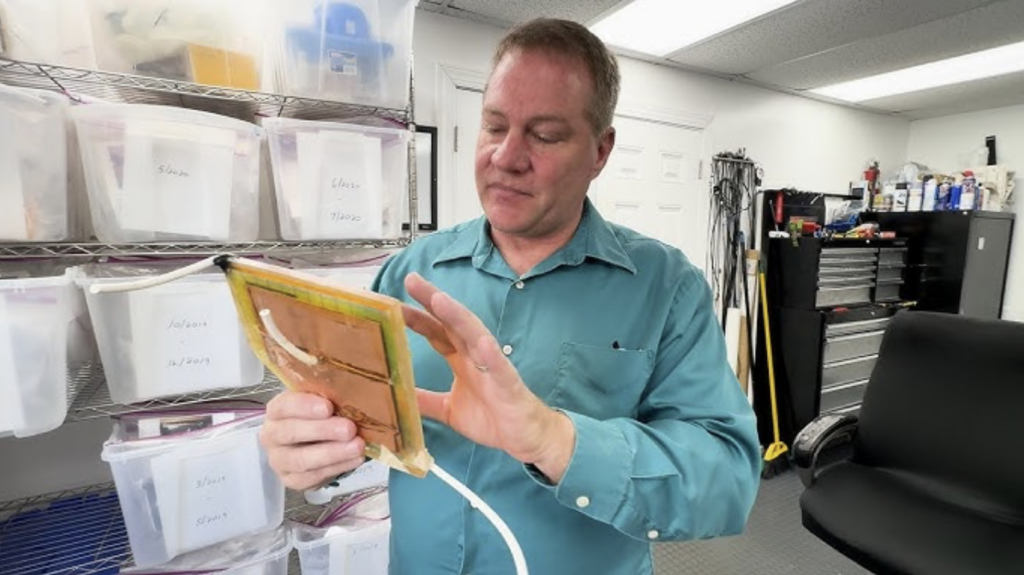
Dr. Charles Buhler, who once led NASA’s Electrostatics and Surface Physics Laboratory at Kennedy Space Center, has stepped forward with one of the most explosive claims in modern aerospace: his private company has developed a device that generates thrust using nothing but electric fields—no fuel, no exhaust, no expelled mass.
In carefully controlled vacuum chamber tests, Buhler says hardware developed by Exodus Propulsion Technologies produced enough force to counteract Earth’s gravity. If independently confirmed, this “Exodus Effect” would represent the first genuine propellantless propulsion system in history, potentially ending the century-long dominance of conventional rockets and opening the door to a radical new era of spaceflight.
For more than 60 years, every spacecraft launched from Earth has been prisoner to the brutal mathematics of the rocket equation. The farther you want to go, the more fuel you must carry—and that fuel itself adds weight that demands even more fuel. The result has been expensive, limited missions and a practical ceiling on human expansion into the solar system.
Buhler’s technology, if real, breaks that chain. A spacecraft equipped with the new drive could theoretically maneuver indefinitely in the vacuum of space, maintaining orbits, exploring distant worlds, or adjusting trajectories without ever burning a drop of propellant. The implications stretch far beyond efficiency. Satellite operators could eliminate costly fuel reserves. Deep-space probes could reach the outer planets on modest solar power. Future crewed missions might shed the massive fuel tanks that currently dominate rocket design.
A longtime expert in electrostatics with experience supporting Shuttle, ISS, Hubble, and Mars programs, Buhler is no outsider or basement inventor. After decades inside the system, he co-founded Exodus Propulsion Technologies and assembled a team of veterans from NASA, Blue Origin, and the U.S. Air Force. Working in a specialized vacuum chamber built to rule out atmospheric interference, the group claims to have repeatedly measured a net force from asymmetric electric fields that persists in hard vacuum.
The deeper physics behind the effect remain under wraps, though Buhler has pointed toward higher-order quantum electrodynamics phenomena. Whatever the mechanism, the team says the force scales in ways that could make it practical for real spacecraft.

Naturally, the claim is being met with sharp skepticism. Critics immediately draw parallels to the infamous EmDrive, which generated headlines for years before independent tests attributed its tiny signals to measurement error and heat. Many physicists argue that true propellantless thrust would violate conservation of momentum, one of the bedrock principles of classical mechanics. Until outside laboratories replicate the results under rigorous conditions, the scientific community is withholding judgment.
Yet the pedigree of the source makes this harder to dismiss than typical fringe claims. A senior NASA electrostatics specialist doesn’t casually risk his reputation on unverified fantasy. The work has been presented at propulsion conferences, patents have been filed, and the team continues iterative testing.
For those who follow suppressed technology narratives, the slow rollout raises familiar questions. Why has a discovery with such staggering strategic importance—unlimited maneuverability in space, dramatically lower mission costs, potential atmospheric applications—not triggered immediate large-scale verification by major agencies?
If the effect is genuine, control over the first practical reactionless drive would confer enormous economic and military advantages. History shows that game-changing propulsion ideas have a tendency to vanish into classified channels or fade quietly from public view.
Should Exodus Propulsion’s results hold up under independent scrutiny, the timeline could accelerate quickly. Orbiting demonstrators might appear within years rather than decades. The age of chemical rockets, long the only game in town, could give way to a new chapter where spacecraft move with an elegance once reserved for science fiction.
Dr. Buhler has described the discovery as a force that could propel humanity for the next thousand years. Whether that future arrives openly or is quietly absorbed by powerful interests remains to be seen.