


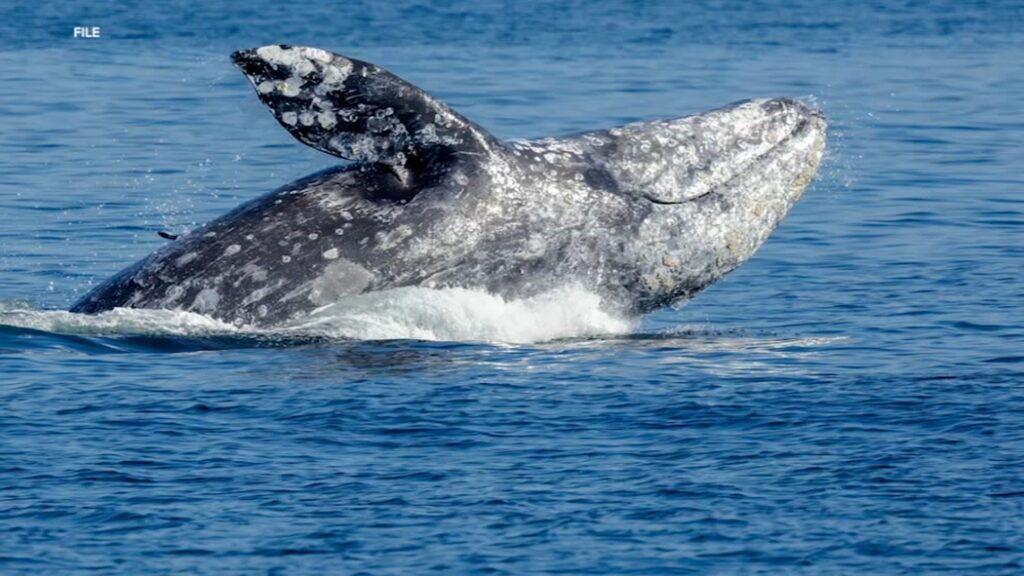
A new study, published this week has found that gray whales in the San Francisco bay have been dying at alarming rates
The Eastern North Pacific (ENP) gray whales have brought wonder, as residents and researchers have managed to get close enough to observe how they feed, breed and socially engage. They’ve also brought growing concern as marine biologists wonder why are so many of them undernourished and dying?
Many of the deaths appear to be caused by collision with vessels.
BBC reports: In 2025, a record number of 21 dead gray whales were found in the broader San Francisco Bay. So far this year, seven have died due to a combination of dwindling prey availability, climate change and human causes, researchers say.
The 4,140-sq-km bay is the largest estuary on the west coast of the US. Before 2018, this species of whales wasn’t known to stop seasonally or consistently in the bay, bypassing it on their migration route down to Baja California and back up the Arctic, said Josephine Slaathaug, who led a recent study on gray whale mortality in the bay.
The impressive gray whales have the longest annual migration of any mammal, travelling an approximate 15,000-20,000km roundtrip to breed.
“It’s a new habitat that they’ve chosen to utilise,” the graduate student at Sonoma State University and the lead author of the paper tells the BBC, noting years of steep declines in their prey in the Arctic.
Many of those that turned up in the bay are adult and juvenile males that are heading to the Arctic. Notably, the whales observed are skinnier than they normally would be at this time of year, Slaathaug and several other researchers tell the BBC.
“They don’t have the energy reserves necessary to complete the entire migration back to the Arctic, so they may be driven into the bay by hunger,” she said.
Dead or dying gray whales have also cropped up in Washington state and Oregon. Although they weren’t included in Slaathaug’s study, researchers believe changes in their behaviours could be related.
While a lack of food may be driving whales into the bay, it’s not necessarily starvation that’s killing them. In recent years, nearly one-fifth of the gray whales that have swum into the San Francisco Bay have died there, usually after being struck by ships, according to Slaathaug’s study published in the journal Frontiers in Marine Science, external this week.
Slaathaug’s study examined hundreds of photographs of whales and carcasses found in the bay since 2018. Her team described “a very concerning high rate of death in San Francisco Bay” that continued to grow in 2025, with whales in the bay highly susceptible to vessel strikes.
Still, researchers say the factors that lead to these deaths are worth exploring. The bay is offering a rare opportunity to better understand migratory patterns and how climate change is shifting routes and food supplies.
“It’s sad to see a dead whale. It’s sadder to see a dead whale that you may have recognised from studying that particular whale. But there’s also a lot that we can learn,” said Kathi George, whose team assisted Slaathaug with her research and several necropsies – animal autopsies.
Whales, she said, can be harbingers of bigger changes under the surface of the ocean.
That the whale sightings and strandings have begun earlier in the season this year – beginning with two in January when peak numbers are usually in April – is a cause for concern, indicating that the creatures are in more trouble than initially thought.
Slaathaug and her colleagues have also seen very low calf counts, signalling a low birth rate. That could mean this population is neither recovering nor rebounding in the way that it has in previous times of population decline.
“That, in combination with the high rate of human-caused mortality in this area, really leads scientists to be concerned and look for ways to find solutions,” Slaathaug said.
Moe Flannery, a co-author of the study, told the BBC that this is the first time in decades where the problem seems immediate. She says scientists are learning how to make the waters from Alaska to Mexico safer for the whales.