


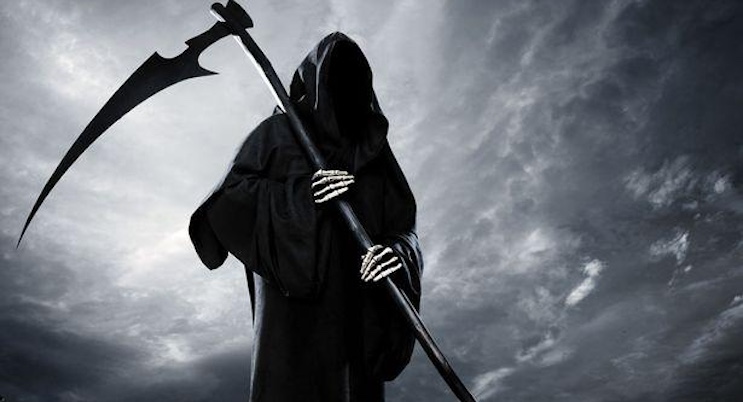
In an age where the average Briton scrolls through many tales of catastrophe even before breakfast, and spends much of their day in a mire of misery, it’s fair to ask if we’ve lost our lust for life.
From TV terror to doom-laden headlines, death is no longer seen as simply a solemn inevitability, but as something thrilling and seductive.
And does anyone get the impression that this stealthy repackaging has been deliberate, that the shadowy architects of policy, politics and culture have orchestrated this discordant symphony of nihilism, coaxing us to embrace mortality in a way we’ve never done before?
UK surveys reveal a populace enthralled by the macabre, who now prefer thrillers to rom-coms. Why has this happened? And at what cost to our souls?
The small screen – accessible, addictive, dangerous – is the modern opium den. Platforms such as Netflix’s skews dark: for every uplifting movie, there seem to be half a dozen ‘descents into the abyss’. Murder-mysteries, horror movies and true-crime dominate. ‘Monster’, a new series starring Charlie Hunnan, dramatising serial killer Ed Gein’s murders and necrophilia, can only be described as horror porn. You may start by watching through your fingers but a few episodes in and it’s easy viewing. The genius of desensitisation is that exposure and repetition numb us, quickly turning revulsion to indifference.
The British Psychological Society research confirms this: habitual violent media erodes emotional reactivity and can make horror a habit. Studies prove that regular viewers of the bad stuff show reduced upset to real violence. It’s addictive too and, like the serial killers they so often watch, they often have to find increasingly horrific programmes to watch in order to satisfy their needs. No wonder they shun the outdoors for their sofas, choosing make-believe thrills over real-life connection.
This rot seeps into news cycles too and now infests the daily banquets of worry, distress and fear we’re served up by the mainstream media. Algorithms hound us with grim tidings: wars, murders, famine death tolls, disasters… Absorbing this type of information every day isn’t normal behaviour – it’s a ritual, training us to stay in the shadow of sadness. A 2021 YouGov survey shows that one in four Britons were more preoccupied with mortality that year, after the chaos of 2020 than they’d ever been before and that nearly half had begun to ruminate about death and dying daily.
It seems many of us now crave adrenaline over calm. Why watch a sitcom when a serial killer box set provides way more tingles? A NatCen study reveals that exposure to chronic “doom and gloom” news heightens ‘demise anxiety’ and fosters a fascination with all things morbid.
Halloween exemplifies the shift. Once a series of Celtic vigils with pumpkin lanterns, it’s now become a slasher parade. A British Heart Foundation survey in 2023 revealed that 68% of trick-or-treaters were donning slasher garb, up from 12% in the 1990s. University of Bath psychologists warned in another study how gore ‘gamifies’ fear and diminishes kids’ responses to real crime and violence. The NSPCC notes a rise post-Halloween “murder games” in school. Death, once sombre, is now just part of playground antics.
Governments play a part in this too and seem to be currently going out of their way to foster death cults amongst the vulnerable. The promotion of euthanasia has not gone unnoticed by the public. Switzerland’s EXIT has seen 3,000+ cases of voluntary euthanasia since 2003, often in non-terminal people. Canada’s MAID has seen 13,000 cases in 2023 and now extends to the mentally unwell, children and the poor. Assisted dying is now routine in 12 US jurisdictions: California, Colorado, Delaware, DC, Hawaii, Montana, Maine, New Jersey, New Mexico, Oregon, Vermont and Washington. Globally, it’s now legal in Belgium, Colombia, Ecuador, Luxembourg, Netherlands, New Zealand, Portugal, Spain, all six Australian states and Uruguay. Patients sign up casually, offing themselves as a lifestyle choice.
But it’s a slippery slope and records show that these kinds of deaths are on the rise. In the Netherlands, for example, cases rose from 1,882 in 2002 to over 8,000 annually currently.
In Britain, the push intensifies. Kim Leadbeater’s Terminally Ill Adults (End of Life) Bill passed its third Commons reading June 2025, allegedly backed by 79% (British Social Attitudes Survey) of the public. In a YouGov survey, 75% deem it a good idea. Are these outcomes organic or are they the result of the blatant indoctrination via TV dramas and dignity in dying’ op-eds? Do we ignore the perils – elderly coercion, NHS pressure, “grandma’s had a good innings” – because we’re told to? Are the decisions we make down to autonomy or mind-control?
Capital punishment has also recently revived favour. Abolished in the UK 1965, a More in Common poll 60 years later shows 55% support for the death penalty for terrorism and serial murder (up 5% since 2023), with support from included millennials at 60%. A YouGov survey showed 40% general support with 57% for crimes of terrorism.
Abortion has also come back into the spotlight in recent years. 2024 amendments to the Abortion Act in the UK sought 24-week decriminalisation in an attempt to protect women managing their own abortions (but it didn’t pass); Canada/Europe whispers further, some wanting ‘up to birth’ termination – an act which many say is just infanticide by another name.
Sudden death reporting grows increasingly opaque as the years go by. According to the ONS, excess mortality lingers, with thousands of deaths above the 2024 baseline, yet unexplained death headlines abound with experts continuing to be “baffled”. UKHS reports no 2025 spikes but abrupt demises continue to be normalised and are rarely probed.
Defibrillators proliferate (5,900+ in schools via Restart a Heart/Oliver King Foundation). Is this progress or a constant reminder we could drop dead any second? Ads amplify this: Cancer Research UK’s 1-in-2 risk; dying kids on sports pitches; BHF murals of young cardiac deaths stare down from tall walls. Health and safety fear porn is everywhere, instructing us to remain fearful of killer viruses, contagious new deadly diseases, oncoming pandemics. Stay vigilant for the next plague, people!
Pre-20th century, death was domestic – a family affair, quiet and private. These days, it’s industrialised, outsourced and aestheticised. It’s no longer a mystery or revered – it’s a basic fact of life, something that has to be dealt with, like putting out the rubbish. Is this a good thing? Some – the young in particular – might say it is.
And what about depopulation? The ‘elites’ have never hidden the fact that they think there’s far too many of us (not of them though!) and that the population could do with a bit of streamlining. They have many methods at their disposal and a lot of folk already believe the process – with added eugenics – is well underway, using infertility (diminished by toxins in food, water, air, vaccines and other meds); the exaltation of gay/trans lifestyles, the promotion of contraception, promiscuity, abortion – all this erodes birth rates. The promotion of euthanasia – horrifically involuntary as well as voluntary – is also clearly happening, with a view perhaps to ultimately living in a ‘Logan’s Run’ type dystopia where we agree or choose to bow out at a certain age and if we refuse we’re given a helping hand.
If you think this sounds crazy, check the patterns, the ONS 2024 fertility of 1.49 amid the WEF “sustainable” rhetoric. It’s all there, in the in the statistics, the white papers and the TED talks.
So will this death cult hypnosis worsen and have us all acquiescent, accepting and ultimately queuing up like suicidal sheep? Or will we snap out of it and reject the overwhelming gloom? The choice is ours: if we choose to look up from the news and scary movies, we stand a chance of breaking free from the burgeoning cult. But if we fail to take drastic action, the grimness will keep on reaping, while we applaud, petrified, paralysed trapped – possibly forever – in a world clouded by death, darkness and destruction.
Don’t say you haven’t been warned.
