


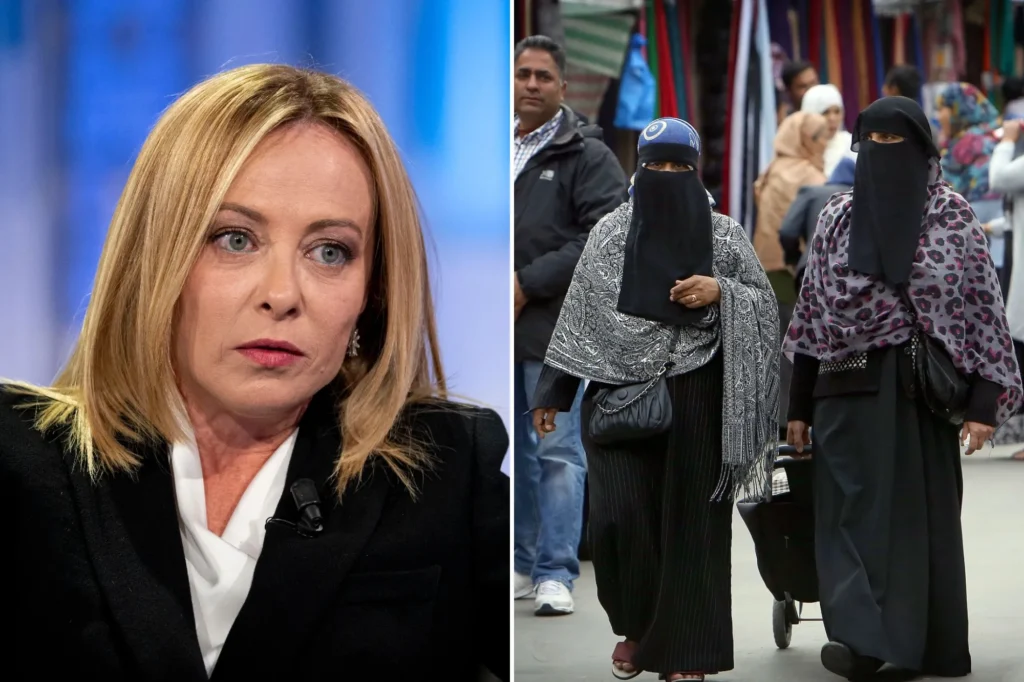
Italy’s ruling Brothers of Italy Party has called for a ban on Islamic clothing that obstructs facial recognition in all public places.
The party of Prime Minister Georgia Meloni presented a bill to parliament on Wednesday which seeks to prohibit garments covering the face, including the burqa and niqab, in all public places, schools, universities, shops, and offices nationwide.
According to a statement released the same day, violations of the ban could result in fines of up to €3,000.
The proposal also bans virginity tests and forced marriage and demands stricter transparency in religious institutions, monitoring foreign funding,
RT reports: In addition to the complete ban on full-face veils in public places, schools, universities, offices, and commercial venues, the proposed measure imposes stricter rules on financial transparency in places of worship, making it easier to trace foreign funding. The draft also calls for banning so‑called virginity tests and harsher penalties for forced marriages, practices the party says violate human dignity.
The move seeks to “protect Italian identity, citizen security, and women’s freedom,” the right-wing ruling party said in a statement, arguing that the measure would not curb religious liberty, but prevent its misuse to justify practices contrary to the constitution and social norms.
The proposed measure provides “concrete tools to stop the spread of fundamentalist practices and opaque financing that threaten security and social cohesion,” according to the party’s MP Galeazzo Bignami.
Italy already has a law, dating from 1975, that prohibits garments fully covering the face in public spaces, primarily targeting helmets or masks used for concealment rather than religious garb.
France became the first European country to fully ban the niqab in public places in 2011, introducing penalties such as fines or community service. Several other countries subsequently implemented similar measures, including Belgium, Austria, Denmark, the Netherlands, and Switzerland. The United Nations has warned that these bans could restrict religious freedom and risk further marginalizing women by limiting their participation in public life.