


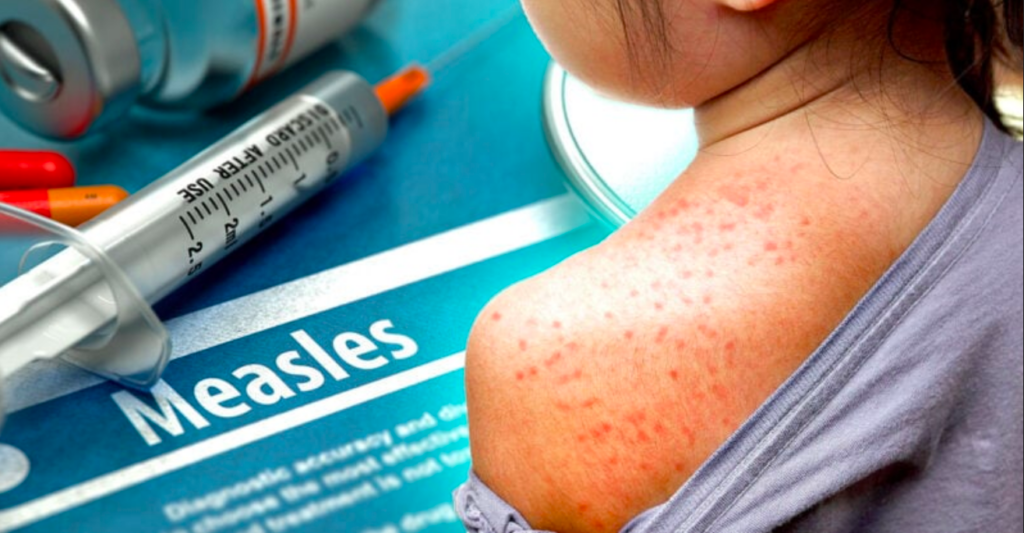
Gaines County, Texas, is experiencing a staggering 2,042% spike in measles cases—right after a public health initiative distributed free measles vaccines.
The outbreak raises serious concerns: Could the vaccine itself be driving the surge?
On February 7, there were just 14 confirmed measles cases in the county. Over the next week, local health authorities launched a mass vaccination effort, administering at least scores of doses of the MMR vaccine, which contains live measles virus known to shed to the unvaccinated.


Then, the outbreak exploded.
By February 14, the Texas Department of State Health Services reported that cases had jumped to 48, marking a 242% increase in just days. Even more concerning, officials now estimate that 200 to 300 people may be infected, representing an 2,042% increase following the vaccination push.
The timing of this outbreak is impossible to ignore.
The MMR vaccine—manufactured by Merck and GlaxoSmithKline (GSK)—contains live but weakened measles virus, according to official FDA package inserts.
“[E]ach approximately 0.5-mL dose contains not less than 3.4 log10 Cell Culture Infective Dose 50% (CCID50) of measles virus, 4.2 log10 CCID50 of mumps virus, and 3.3 log10 CCID50 of rubella virus,” the package insert reads.
Merck’s M-M-R II also “contains live attenuated measles, mumps and rubella viruses,” as per the package insert.
Multiple tudies have confirmed that vaccinated individuals can shed the virus, leading to infections among those around them.
- A 1995 CDC study found that 83% of vaccinated children had measles virus present in their urine.
- A 2012 peer-reviewed study in the peer-reviewed journal Paediatrics & Child Health documented a child shedding vaccine-strain measles virus after receiving the shot.
- A 2014 study in Clinical Infectious Diseases confirmed that vaccinated individuals can transmit measles to others.
Despite these findings, health officials continue pushing for widespread vaccination, dismissing any concerns that the very solution they promote may be fueling outbreaks.
Could Gaines County be the latest example of this overlooked risk?
