


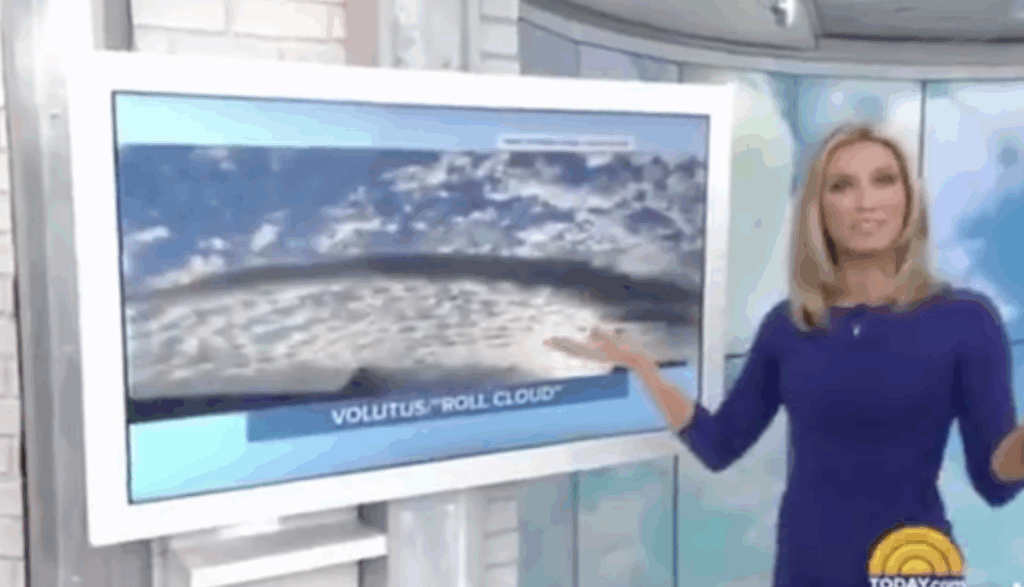
In a move to normalize chemtrails and gaslight the public, meteorologists have officially added new cloud types to the International Cloud Atlas — and several of them are directly linked to geoengineering activity.
Among the most striking additions is the Volutus, or “roll cloud” — described as a “whole new species” with its long, tube-like shape stretching across the horizon. Scientists say it forms naturally, but anyone who’s looked up lately knows the skies haven’t looked “natural” for a long time.


Then there’s the Cavum, also known as the “hole punch cloud.” This bizarre circular gap appears when planes take off or land, disrupting the cloud layer and creating what experts now call a new “phenomenon.”
In plain English: the skies are literally being punched open by aircraft — and now it’s being normalized.


The Asperitas cloud, which mainstream weather hosts are already calling “gorgeous” and “like a glaze,” looks more like rippling waves of distortion, the kind you might expect after atmospheric manipulation or electromagnetic interference.
But of course, the media calls it “beautiful.” Watch:
“It looks like waves while you’re underwater.
— Concerned Citizen (@BGatesIsaPyscho) November 5, 2025
Sheepletons actually believe Legacy Media when they claimed to have suddenly found a range of New Clouds that everyone magically started witnessing one day.
Then the same people claimed the trails from planes had always left lines… pic.twitter.com/dteD7xSAXl
And finally, the Fluctus — those “big surfer waves” in the sky — yet another strange, turbulent formation that didn’t appear in your grandparents’ weather books.


Meteorologists call this a “historic update.” But to many skywatchers and truth-seekers, it feels more like the official codification of geoengineering — the moment they quietly admitted that the skies have changed, and humanity had nothing to do with it.
So the next time you look up and see strange, rolling waves, hollow rings, or tube-like streaks cutting across the heavens — remember: these are not the clouds our grandparents saw when they looked at the sky.