



A new peer-reviewed study claims that “hypersexuality” is a symptom of ADHD and should be considered a clinical factor in cases of infidelity.
In the study published in the Journal of Affective Disorders Reports, a group of Italian psychology researchers found a correlation between attention-deficit/hyperactivity disorder (ADHD), depressive symptoms, mania and hypersexuality, or a strong preoccupation with sex.
According to the study, hypersexual people who experience these symptoms may use sex as “self-medication.”

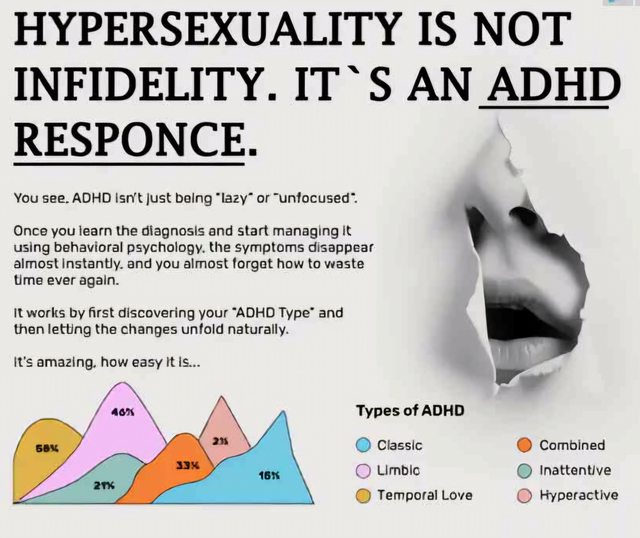
Yahoo reports: Study co-authors Giacomo Ciocca, a sexual psychology assistant professor at Rome’s Sapienza University, and Davide Doroldi, a clinical psychologist, told PsyPost that they were inspired to look into the possible link after observing higher rates of hypersexuality among people with ADHD.
the Italian psychologists assessed ADHD symptoms and occurrence of hypersexuality for 309 participants ranging in age from 18 to 79. They found that respondents’ hypersexual thoughts and acts seemed to increase when they were either depressive, manic, or in slightly psychotic states.
One key factor, as previous studies have shown, seems to be impulsivity — which, of course, people with both ADHD and hypersexuality struggle with. When experiencing depression or hypomania, however, people may also use sex to calm down or alleviate stress, and not just be doing so out of impulsiveness, the scientists argue.
“Strong negative emotions and difficulties in emotional regulation trigger sexual behavior, which is used as an emotion-based coping strategy,” the researchers told PsyPost.
“Individuals with ADHD, partly because of the problems due to the condition, are particularly vulnerable to dysphoric emotional states.”
Notably, the study skewed largely female, with more than 67 percent of respondents in the sample being women. While that reflects a need for further research into this relationship, it also shines a light on both ADHD and hypersexuality in women, both of which have been understudied, stigmatized, and misunderstood for years.
As the Italians noted to PsyPost, hypersexuality “often characterizes many psychopathological conditions” and is “a consequence of some major mental diseases.”
In the case of this new research, however, it can also be something of a coping mechanism — which not only could reduce the pathologization of such behaviors and thoughts, but could help the psychiatric community better understand the way people who live with ADHD experience the world, too.
