


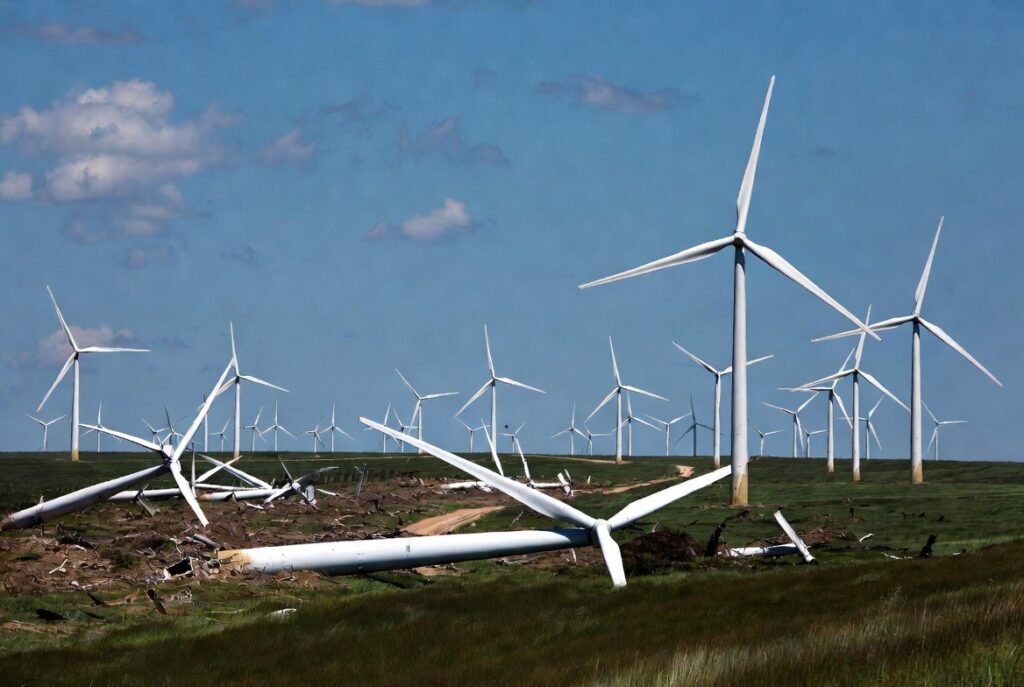
A sprawling wind farm in South Dakota, celebrated for years as a symbol of America’s green energy future, has been left in ruins after being battered by one thing it was supposedly built to master: the wind.
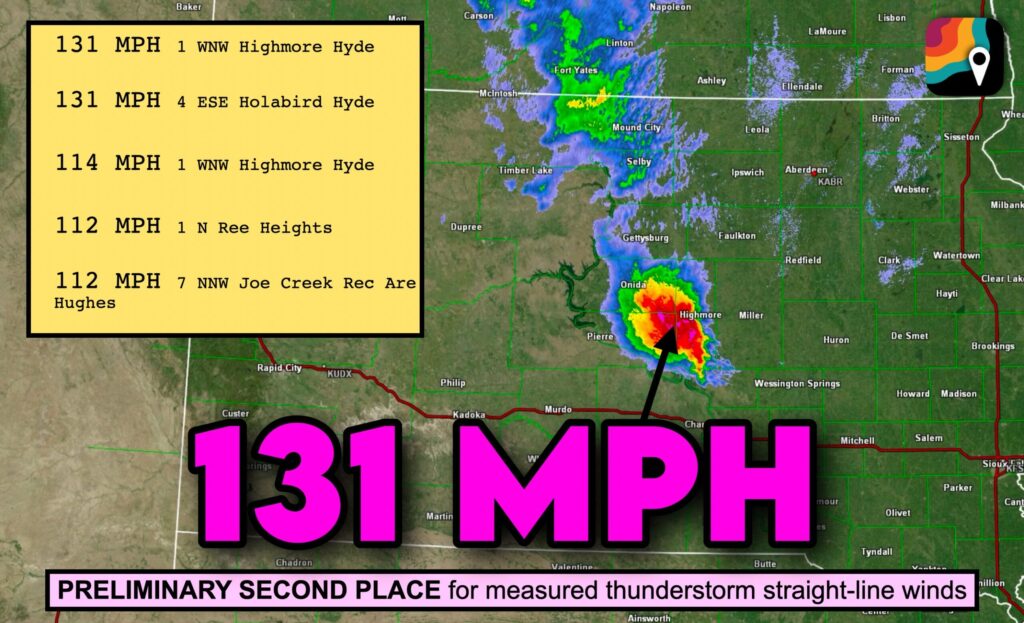
As a powerful thunderstorm tore across central South Dakota early Tuesday morning, straight-line winds reportedly reached an astonishing 131 miles per hour near the town of Highmore. When the storm passed, the South Dakota Wind Energy Center looked less like the future of clean energy and more like the aftermath of a natural disaster.
According to storm chaser Jakob McMillin, who documented the destruction in videos and photographs that quickly spread across social media, more than 20 of the facility’s 27 giant wind turbines appeared to have collapsed or suffered catastrophic damage. Tower sections lay crumpled across the prairie while enormous fiberglass blades were snapped apart and scattered across surrounding farmland.

The irony was impossible to miss.
For years, politicians and climate activists have insisted that industrial wind power represents the future—a modern, resilient replacement for conventional energy sources. Yet one severe weather event appears to have taken most of an entire power-generating facility out of service in a matter of minutes.
The South Dakota Wind Energy Center, commissioned in 2003, was the state’s first major commercial wind project. Operated by NextEra Energy Resources, the site consists of 27 turbines with a combined generating capacity of 40.5 megawatts, enough under ideal conditions to supply electricity to roughly 12,000 homes.
Today, much of that infrastructure lies twisted on the ground.
Supporters of renewable energy frequently argue that society must dramatically expand wind generation to prepare for a future of increasingly extreme weather driven by climate change. But incidents like this inevitably raise uncomfortable questions.
If the infrastructure designed to withstand nature’s forces can itself become a casualty of those forces, just how resilient is the system being promoted as the backbone of tomorrow’s electric grid?
Wind turbines are certainly engineered to tolerate powerful gusts, but engineering specifications on paper often collide with the unpredictable realities of the natural world. Steel towers, composite blades and massive mechanical assemblies all have breaking points, and Tuesday’s storm appears to have found them.
Each turbine represents a multi-million-dollar piece of infrastructure requiring specialized cranes, transportation, engineering inspections and replacement components that cannot simply be ordered overnight.
Questions are now emerging that rarely receive much attention whenever new wind projects are announced. Who ultimately pays to replace destroyed turbines? How much electricity will be lost while the site remains out of operation? Will insurance absorb the enormous costs, or will consumers eventually see them reflected in higher electricity prices?
Those discussions are unlikely to feature in the glossy promotional campaigns that typically accompany renewable energy developments.
For years, the public has been told that wind farms are the inevitable future of electricity generation. But nature has a way of reminding mankind that no technology is invincible.
In South Dakota this week, the very force that these towering machines were designed to capture became the force that brought many of them crashing back to earth.
For critics of the green energy agenda, it was a picture worth a thousand government press releases.