


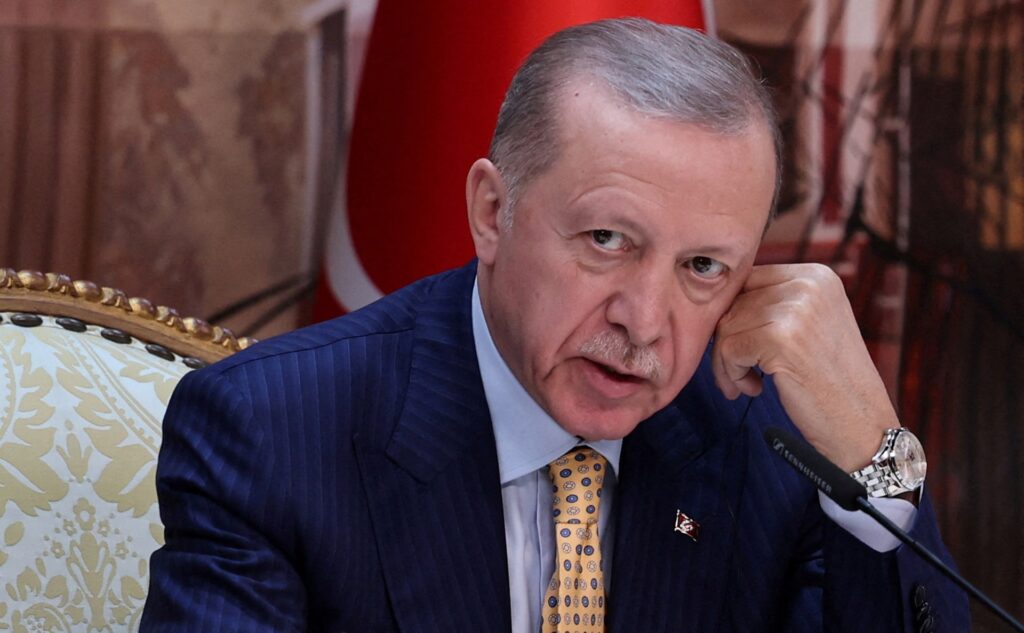
Turkish President Recep Tayyip Erdoğan has issued a blunt threat of military action against Israel, saying Turkey is prepared to intervene as it has in past regional conflicts.
“There is no reason why we should not do it,” he said—words that cut through the thin veil of diplomacy and land with the force of a direct threat. This is not background noise. This is the language of escalation.
The response from Israel was swift and scathing. Heritage Minister Amichai Eliyahu fired back, branding Erdoğan a “self-obsessed dictator.” The exchange was more than political theater—it was a glimpse into a rapidly hardening confrontation between two regional powers now speaking in the open language of conflict.
And the timing could not be more dangerous.
The Middle East is already a live wire. Israel is locked in overlapping tensions with Hamas in the Gaza Strip, under constant threat from Hezbollah in Lebanon, and engaged in a shadow war with Iran that has been inching closer to open confrontation. Into this volatile equation now steps Turkey—not as a distant observer, but as a potential direct actor.
This is how wider wars begin.
Because Turkey is not isolated. It is a member of NATO. Israel is deeply aligned with the United States. Every move, every strike, every miscalculation now carries the risk of pulling in forces far beyond the region.
And beyond that lies an even larger fault line.
The world is already divided between competing power centers. Russia and China are watching, calculating, waiting. A regional war in the Middle East would not unfold in isolation—it would intersect with global rivalries already simmering in places like Eastern Europe and the Pacific.
The result would not be a contained conflict.
It would be a cascade.
What makes Erdoğan’s statement so dangerous is not just the threat itself—it is what it represents. The normalization of war talk. The erosion of restraint. The growing willingness of leaders to speak openly about military intervention as if it were just another policy option.
History has seen this before.
Great conflicts are rarely declared in a single moment. They build. A statement here. A retaliation there. A line crossed, then another. Until suddenly, the machinery of war is no longer hypothetical—it is in motion.
That is the moment the world may be approaching now.
No one actor controls the trajectory anymore. Not Turkey, not Israel, not even the great powers behind them. The system itself is becoming unstable—driven by pressure, pride, and the dangerous illusion that escalation can always be managed.
Erdoğan’s threat is not the beginning of a world war.
But it may be exactly the kind of moment history looks back on—and asks why no one stopped the slide when there was still time.