
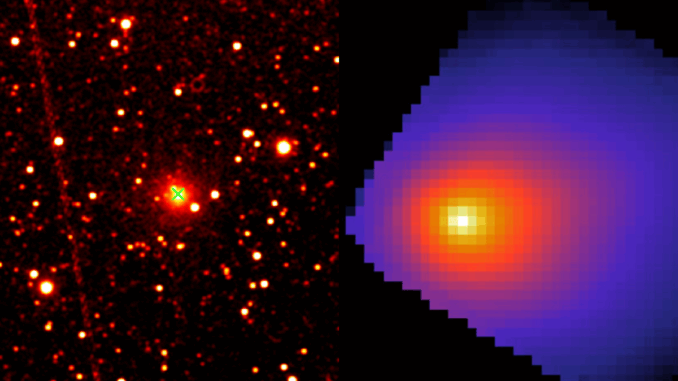
A new paper based on spectroscopic data from the European Southern Observatory’s Very Large Telescope (VLT) has dropped a bombshell: the interstellar object known as 3I/ATLAS is leaking nickel without iron into space.

That may not sound shocking at first, but in astrophysics, it’s a giant red flag. Nickel and iron are cosmic twins — born together in the fiery hearts of supernovae. Wherever we see nickel in nature, we see iron right alongside it. The absence of iron is, quite simply, unnatural.
So why is 3I/ATLAS giving off pure nickel?

BYPASS THE CENSORS
Sign up to get unfiltered news delivered straight to your inbox.
You can unsubscribe any time. By subscribing you agree to our Terms of Use
The answer, some argue, points to technology rather than geology. Nickel without iron is exactly the kind of signature seen in industrial refining of nickel alloys on Earth.
Johnny Depp Reveals Leonardo DiCaprio 'Killed a Child Escort' on Titanic and 'Fed Her to the Crew'
A Trail of Anomalies
This is not the first puzzle surrounding 3I/ATLAS. Previous observations from NASA’s SPHEREx and the James Webb Space Telescope showed that its gas plume is 95% carbon dioxide and only 5% water, the opposite of what a normal comet should look like.
And although SPHEREx data implied a nucleus as large as 46 kilometers across, the Hubble Space Telescope found no cometary tail where one should have been.
Now, with VLT spectroscopy, we can add two more anomalies:
- Nickel leaking at about 5 grams per second at 2.8 AU from the Sun, with the loss rate exploding as the comet gets closer.
- Cyanide (CN) gas gushing out at 20 grams per second, also rising sharply with solar proximity.
Together, nickel and cyanide form a chemical profile eerily similar to nickel–cyanide coatings — a standard anti-corrosion treatment in metallurgy, but utterly alien in nature.
Nature’s Exotic Excuse
The scientific paper tries to offer a natural explanation: perhaps the nickel comes from an exotic chemical pathway known as the nickel carbonyl channel. But this pathway is so rare and unstable in comets that it has never been observed before. Meanwhile, nickel carbonyl is a routine step in industrial nickel refining on Earth.
Which seems more likely? That we’ve stumbled on the most exotic comet in the galaxy — or that 3I/ATLAS isn’t a comet at all?
A Stranger From the Stars
If the light from 3I/ATLAS is mostly coming from its surface, then it is a million times more massive than the previously discovered interstellar comet, 2I/Borisov. Statistically, that’s nearly impossible. We should have spotted a million smaller objects before finding something this big.
And yet here it is — perfectly aligned with the ecliptic plane of the planets, as though it deliberately navigated toward the inner solar system.
Coincidence? Or design?
The Big Question
3I/ATLAS continues to defy expectations. No comet should behave this way. No natural body should leak industrial signatures like nickel without iron and cyanide at industrial levels.
So we’re left with a provocative question: Is 3I/ATLAS just a comet with once-in-a-universe chemistry? Or is it something else entirely — a probe, a relic, or a piece of technology not made on Earth?
For now, the evidence is mounting — and 3I/ATLAS is looking less and less like just another rock from the stars.