
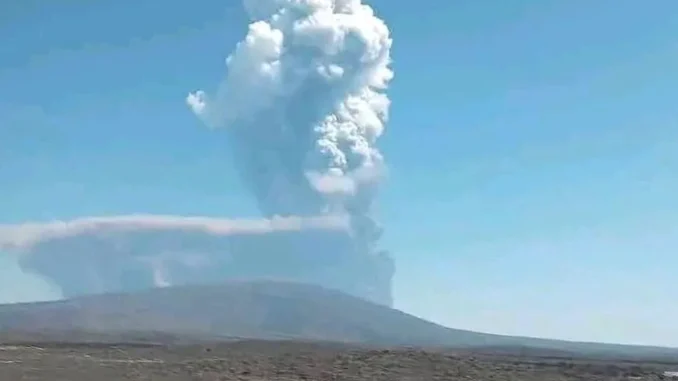
A Volcano in Ethiopia erupted for the first time in nearly 12,000 years on Sunday.

The Hayli Gubbi volcano in Ethiopia’s Afar region near the Eritrean border, erupted sending a vast ash cloud across major air corridors in the Red Sea and forcing airlines in India and the Middle East to cancel or divert flights.
The volcano, which lies about 15 km southeast of the active Erta Ale volcano, erupted on Sunday for several hours, spewing ash up to 14km (nine miles) into the atmosphere.

BYPASS THE CENSORS
Sign up to get unfiltered news delivered straight to your inbox.
You can unsubscribe any time. By subscribing you agree to our Terms of Use
The Independent reports: Thick plumes were tracked drifting over Yemen and Oman before spreading across Pakistan and into northern India on Monday and Tuesday, according to the Volcanic Ash Advisory Centre and the India Meteorological Department.
Johnny Depp Reveals Leonardo DiCaprio 'Killed a Child Escort' on Titanic and 'Fed Her to the Crew'
Local officials said there were no casualties, but villages close to the eruption were blanketed in ash. Mohammed Seid, an Afar regional official, told reporters that while no people or livestock were killed, “many villages have been covered in ash and as a result their animals have little to eat”.
Residents said they heard loud explosions and shockwaves.
“It felt like a sudden bomb had been thrown with smoke and ash,” said Ahmed Abdela, a resident of the Afar region, where ash covered homes and stranded travellers heading towards the Danakil desert.
The Smithsonian Institution’s Global Volcanism Program says there is no known record of Hayli Gubbi erupting during the Holocene, the geological period beginning roughly 12,000 years ago. Simon Carn, a volcanologist at Michigan Technological University, said on the social media platform Bluesky that the volcano “has no record of Holocene eruptions”.
The drifting ash led to significant disruption across India’s western and northern airspace. Air India said it cancelled 11 flights on Monday and Tuesday to carry out precautionary checks on aircraft that had flown near affected regions, following a directive by India’s aviation regulator.
Akasa Air cancelled services to Jeddah, Kuwait and Abu Dhabi, while IndiGo diverted a Kannur-Abu Dhabi flight to Ahmedabad on Monday night.
KLM also cancelled a flight from Amsterdam to Delhi due to the volcanic ash plume.
Airports across Mumbai, Delhi, Jaipur and parts of Gujarat and Rajasthan warned passengers to expect delays and cancellations. Mumbai airport issued an advisory saying the ash cloud could affect some international routes and urged passengers to check schedules before travelling.
India’s directorate general of civil aviation instructed airlines to avoid affected altitudes, monitor real-time advisories and inspect runways for possible ash contamination. Airlines said they were prioritising safety while keeping operations under review.
The ash plume arrives in northern India amid already dire air quality, with several protests ongoing. There were some public concerns that the ash cloud could worsen air quality further, although experts said it was unlikely to impact the Air Quality Index (AQI).
The ash cloud travelled over Delhi overnight, according to Dr Mrutyunjay Mohapatra, the director-general of meteorology at the India Meteorological Department, and was travelling over Eastern India on Tuesday evening at a speed of 100-150 kmph.
It was expected to then pass over Bangladesh, parts of Myanmar and China and may reach the southern coast of Japan.