
A Silicon Valley biotech startup linked to a cabal of billionaires has revealed plans to grow brainless human bodies—dubbed “organ sacks”—for medical experimentation and organ harvesting, while admitting the company is a “federal asset.”

The company, R3 Bio, then attempted to stop the publication of the interview amid criticism that Silicon Valley’s quest to engineer human life is rapidly veering into territory that amounts to playing God.
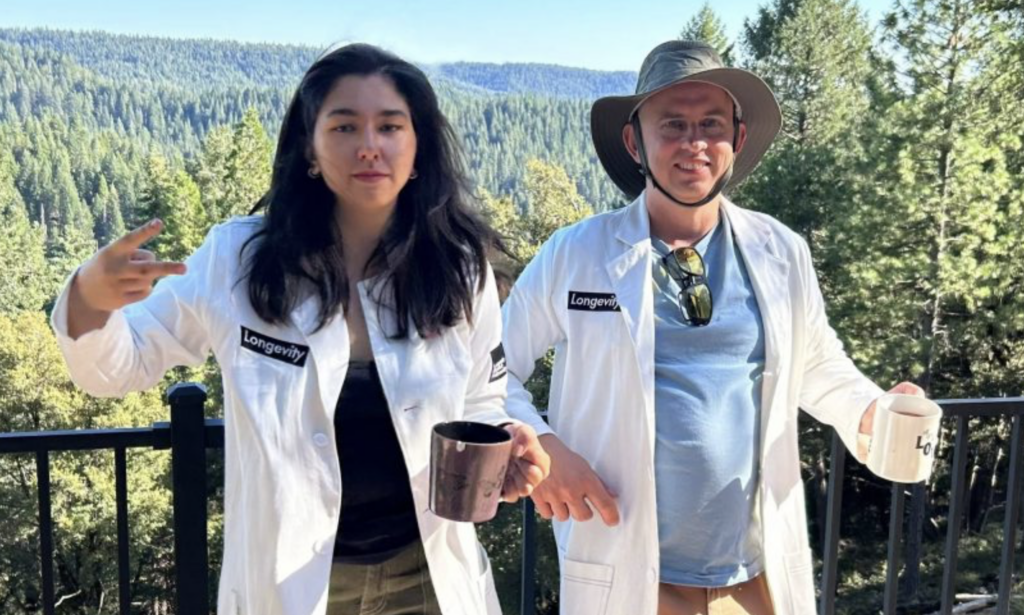
The controversy erupted after R3 Bio co-founder and Chief Operating Officer Alice Gilman described the concept during a podcast interview. The idea, she said, is to create bodies containing hearts, lungs and other organs, but without the brain development necessary for consciousness.

BYPASS THE CENSORS
Sign up to get unfiltered news delivered straight to your inbox.
You can unsubscribe any time. By subscribing you agree to our Terms of Use
“It’s just pretty much a heart, lungs, and everything that you would find in a body,” Gilman explained. “But it’s not technically alive because it’s exclusively the organs.”
Johnny Depp Reveals 'Cannibal' Mark Zuckerberg 'Ate His Own Baby' to Stay in Illuminati
The company says such technology could one day solve organ shortages and replace animal testing. Critics hear something very different: the industrial production of human bodies designed to be used and discarded.
Adding to the controversy, the podcast’s producers say Gilman later attempted to delay publication of the interview and referred to R3 Bio as a “federal asset,” while declining to explain exactly what the company is working on.
Then came perhaps the most unsettling comment of all.
“Just because we don’t talk about a lot of things, that doesn’t mean they’re not happening,” Gilman said.
The remark has only intensified questions about what may be happening behind the closed doors of advanced biotechnology labs.
But R3 Bio is not some isolated company operating on the scientific fringe. It is emerging from a rapidly growing Silicon Valley movement that sees aging and even the human body itself as engineering problems waiting to be solved.
One of the company’s investors is billionaire venture capitalist Tim Draper, whose portfolio is filled with moonshot technologies aimed at disrupting entire industries. R3 Bio is also backed by longevity-focused investment firms that believe human biology can be radically redesigned.
This philosophy has become increasingly popular among some of the world’s wealthiest tech figures.
Peter Thiel has long funded anti-aging research and argued that death should be fought rather than accepted. Jeff Bezos has poured money into Altos Labs, a company attempting to reverse cellular aging. Oracle founder Larry Ellison has spent hundreds of millions of dollars on longevity research, while OpenAI chief Sam Altman has invested in life-extension startups.
There is no evidence that any of those billionaires are involved with R3 Bio.
But the startup is clearly swimming in the same intellectual waters.
The common thread running through this movement is the belief that the human body is ultimately a machine—one that can be repaired, upgraded, redesigned and perhaps one day entirely replaced.
Seen through that lens, the idea of growing “headless bodies” for spare organs is not a bizarre anomaly. It may be the logical next step in a worldview that increasingly treats biology as programmable technology.
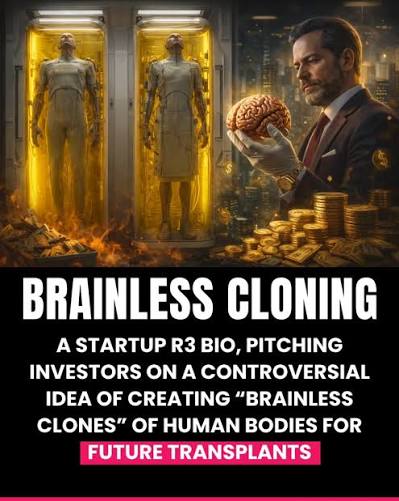
R3 Bio has denied that it is creating human clones or intentionally brain-damaged humans, and the company says it has no ongoing work involving full-scale human organ fabrication.
Even so, the debate surrounding the startup has exposed a question that until recently belonged in dystopian fiction:
If scientists can manufacture human bodies without consciousness, who decides where the ethical line is drawn?
For decades, Silicon Valley promised to disrupt transportation, communication and finance. Now some of its wealthiest investors are setting their sights on the human body itself.
The question facing society is no longer whether biotechnology will transform medicine.
It is whether a tiny group of billionaires, venture capitalists and biotech entrepreneurs should have the power to decide how far humanity goes in redesigning human life—and whether, in the pursuit of defeating death, they have begun playing God.