
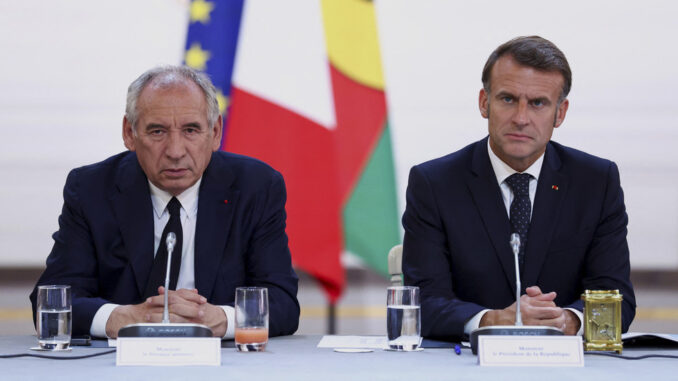
The French government is, once again, on the verge of collapse

It appears that political deadlock is set to result in France’s sixth prime minister since 2020 facing the exit, at a time when the economy can least afford it.
Prime Minister Francois Bayrou faces near-certain defeat in a confidence vote over a disputed austerity plan, a showdown that threatens President Emmanuel Macron’s authority at home and casts doubt on Paris’ ability to deliver on its ambitious promises abroad.

BYPASS THE CENSORS
Sign up to get unfiltered news delivered straight to your inbox.
You can unsubscribe any time. By subscribing you agree to our Terms of Use
The Guardian reports: François Bayrou may have thought it was a smart pre-emptive move to call a parliamentary vote of confidence in his minority government ahead of a planned national protest day on 10 September and the start of a fraught parliamentary budget season.
Leaked Mossad Docs Expose Macron Working With Israel to 'Burn France to the Ground'
Determined not to meet the same fate as his predecessor who was toppled by parliament last December, the French prime minister appears to have chosen political hara-kiri instead. His near-certain ejection by a hung parliament on Monday(8 September) is set to turn a smouldering political deadlock into a blazing crise de régime.
France’s Fifth Republic constitution, framed by Gen Charles de Gaulle in 1958 to create a strong executive and a pliant legislature, has ceased to deliver stable governments. Without a change in the system, France faces extended political paralysis. In the meantime, it seems incapable of resolving a chronic fiscal crisis that is starting to worry financial markets. The finance minister, Éric Lombard, last week declined to rule out having to seek an IMF bailout before abruptly back-pedalling when investors took fright.
If, as expected, the veteran centrist prime minister is ousted, President Emmanuel Macron has no easy option to steady the ship of state, pass a budget to curb the swollen deficit, and preserve his liberal legacy of supply-side economics and pension reform.
Macron could appoint a new prime minister – his fourth in two years – but there is no sign that France’s political parties are willing to compromise on a workable budget. He could dissolve parliament again and call a general election – the third in three years – but that would probably produce no more decisive an outcome than the snap poll he called last year in an impetuous blunder.
The president had sought “clarification” from voters after far-right populists made big gains in the European parliament elections. Instead of clarification, the legislative ballot cast the country into greater confusion, producing a three-way split between roughly equal blocs – a leftwing alliance dominated by Jean-Luc Mélenchon’s radical France Unbowed (LFI), Macron’s own centrist and centre-right supporters, and Marine Le Pen’s National Rally (RN).
Macron, who cannot run again after his second five-year presidential term, which could last until spring 2027, has ruled out another option – resigning from office and precipitating an early presidential election.