
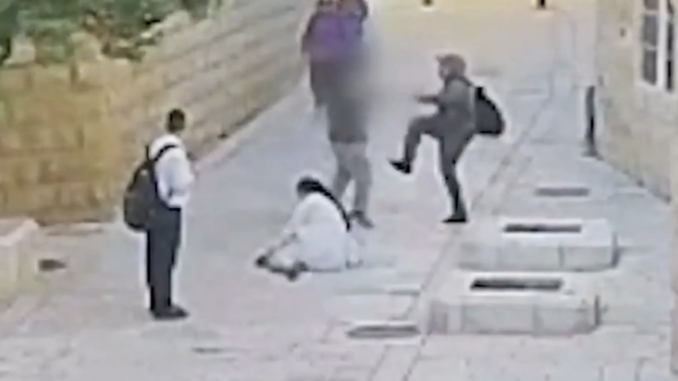
In a horrifying incident captured on chilling surveillance footage, a French Catholic nun was brutally shoved to the ground and repeatedly kicked in the head in broad daylight near one of Christianity’s most sacred sites in Jerusalem.

The attack, which occurred on April 28 in front of the Cenacle on Mount Zion—the site of the Last Supper—has fueled growing fears that anti-Christian hostility in Israel is reaching dangerous new heights.
The victim, a 48-year-old researcher affiliated with the prestigious École Biblique et Archéologique Française (French Biblical and Archaeological School), was walking in the area when a 36-year-old man approached from behind, violently pushed her onto the pavement, causing her to strike her head, and then returned to kick her while she lay defenseless.

BYPASS THE CENSORS
Sign up to get unfiltered news delivered straight to your inbox.
You can unsubscribe any time. By subscribing you agree to our Terms of Use
Photos released by authorities show visible bruising and blood on her face. Israeli police arrested the suspect the same day on suspicion of a “racially motivated assault,” but many are asking: why does it take viral video for action to be taken?
Scientists Warn Ozempic Is Causing a 'Massive Genocide' as REAL Weight Loss Secret Is Covered Up
This is no isolated event. Reports from monitoring groups like the Rossing Center for Education and Dialogue document a disturbing surge in harassment and violence against Christians in Jerusalem and surrounding areas.
Every year, hundreds of incidents are recorded—including spitting on clergy in distinctive religious garments, vandalism of churches and holy sites, physical assaults, pepper-spraying, graffiti, and even arson attempts.
Clergy and nuns are frequent targets precisely because their habits and crosses make them visible symbols of the faith. The Armenian Quarter and routes like the Via Dolorosa have become hotspots for such aggression, often carried out by ultra-Orthodox or religious-nationalist extremists.
While mainstream outlets sometimes downplay these attacks as the work of “lone extremists” or “settlers,” the sheer volume tells a different story.
Christian leaders and local residents describe a climate of intimidation where priests and nuns are routinely cursed, shoved, or subjected to degrading acts in the very streets where Jesus walked. Church properties face repeated desecration—statues smashed, cemeteries vandalized, signs defaced.
One report warned that such incidents represent only “the tip of the iceberg,” with many victims staying silent out of fear or exhaustion.