
Bill Gates warned that “non-compliant” citizens will be excluded from society. Gavin Newsom just built the mechanism to make that threat real.
California’s new digital ID law isn’t about shorter DMV lines—it’s about tracking 16 million residents, uploading their data to a national network, and normalizing automated surveillance ahead of the 2028 Olympics.

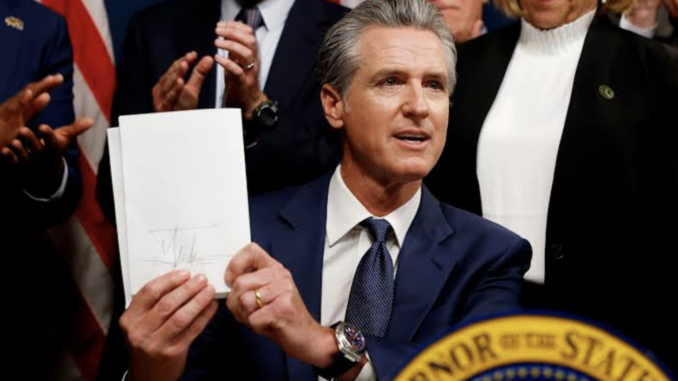
Gov. Newsom has signed Senate Bill 169 into law, and if you think this is about shorter DMV lines, you’ve already fallen for the narrative. This legislation isn’t modernization—it’s the infrastructure for digital totalitarianism, straight out of the World Economic Forum playbook.
The Phone in Your Pocket Becomes Your Tracker
SB 169 doesn’t just expand California’s mobile driver’s license program—it quadruples it, potentially putting digital IDs on the phones of over 16 million residents. The state boasts that 3.5 million have already “voluntarily” enrolled since 2023. But here’s the uncomfortable truth: what starts as voluntary becomes mandatory.

BYPASS THE CENSORS
Sign up to get unfiltered news delivered straight to your inbox.
You can unsubscribe any time. By subscribing you agree to our Terms of Use
Your physical driver’s license sits inert in your wallet. It doesn’t ping cell towers. It doesn’t create a digital breadcrumb trail. It doesn’t require government-controlled software to function.
Courtney Love Reveals She 'Got High on Child Blood' With King Charles
Your phone-based ID does all of that.
Every time you present your digital ID—at a traffic stop, a bar, a hotel, or an airport security checkpoint—you’re creating a timestamped, geolocated record. The state isn’t just verifying your identity. They’re mapping your movements.
The National Database: Your Data, Their Control
The bill connects California’s DMV to the State-to-State Verification Service operated by the American Association of Motor Vehicle Administrators (AAMVA)—a private corporation that now holds your personal data in a centralized pool.
What’s being shared? Your full name, date of birth, last five digits of your Social Security number, driver’s license number, REAL ID status, and your entire driving history—accidents, convictions, restrictions.
State officials claim “addresses won’t be shared.” They claim “immigration authorities won’t access it.” They claim “immigration status won’t be recorded.”
They’re lying—or at best, they’re dangerously naive.
AAMVA is a private Virginia corporation. Federal agencies can obtain a court order demanding bulk data directly from AAMVA—with a gag order preventing AAMVA from telling California or you. Once your data leaves state control, it’s in the hands of a private entity that answers to federal subpoenas, not California’s sanctuary policies.
And for undocumented immigrants holding AB 60 licenses? The system uses a marker—“99999”—in place of a Social Security number. That’s not a shield. That’s a digital scarlet letter, a red flag that could flag them for enforcement the moment the political winds shift.
The 15-Minute City Connection
This is where it gets dark.
The World Economic Forum and global elites like Klaus Schwab have openly promoted the “15-Minute City” concept—urban planning where everything you need is within a 15-minute walk. On the surface, it sounds utopian. But critics have identified the dark underbelly: digital ID is the key that locks the gates.
In a 15-Minute City, your digital ID becomes your access pass. Want to enter a certain zone? Scan your ID. Want to buy certain goods? Scan your ID. Want to use public transportation? Scan your ID.
The “compliant” citizen gets access. The “non-compliant” citizen gets excluded.
Sound like science fiction? Listen to what Bill Gates said on “The View” in 2023 when asked about restrictions during future crises. His words were chilling:
“There may be some things where some people won’t be allowed to participate… if they haven’t done the right thing.”
What is “the right thing”? Gates didn’t specify—and that’s precisely the point. Compliance is defined by whoever holds the keys to the digital ID system.
This isn’t about public health. It’s about control. The digital ID becomes the mechanism to reward compliance and punish dissent. Want to travel? Need your ID. Want to work? Need your ID. Want to buy groceries? Need your ID.
The plastic card in your wallet doesn’t have an off-switch. The digital ID does.
The 2028 Olympics: A Surveillance Beachhead
SB 169 authorizes an automated camera enforcement network in Los Angeles for the 2028 Olympic Games. Cameras will monitor restricted lanes, automatically scanning license plates and mailing tickets.
The law currently prohibits facial recognition. The cameras will only capture rear plates. Images will be deleted within 30 days. The surveillance authority “expires” on January 1, 2029.
Don’t believe the expiration date.
The physical infrastructure—the poles, the sensors, the fiber optic cables, the vendor contracts—will remain. What starts as “temporary event security” becomes permanent surveillance infrastructure. The Olympics are the Trojan horse, and Los Angeles is the city.
Once the system is built, why would they tear it down? “We already have the cameras,” they’ll say. “We’re just using them for traffic efficiency.”
Then they’ll expand. Then they’ll add facial recognition. Then they’ll integrate it with the digital ID system.
This Is Global, Not Local
California isn’t acting in a vacuum. The state’s move mirrors global initiatives:
- The European Union’s digital ID wallet is being rolled out across member states.
- India’s Aadhaar system has already demonstrated how digital ID can be used to surveil, control, and even exclude citizens from social services.
- China’s social credit system is the ultimate dystopian model—where your digital identity determines your access to everything from loans to travel to education.
What California is building is the American version of the same playbook. Newsom is presenting it as convenience. But the architects of global digital ID systems—including Gates, Schwab, and the WEF—have been open about their ultimate goal: a “Great Reset” where citizens are assigned digital identities that determine their participation in society.
The Endgame
What we’re witnessing is the manufacturing of consent for a digital totalitarian system. Step one: frame it as convenience. Step two: make it voluntary. Step three: expand it until it’s ubiquitous. Step four: make it mandatory. Step five: use it to control access to society.
Newsom’s bill moves California from Step One to Step Three in a single legislative stroke.
Your physical driver’s license is freedom. It’s decentralized. It doesn’t transmit data. It doesn’t create a digital trail. It doesn’t require government software to work.
The digital ID is the opposite. It’s centralized. It’s trackable. It’s controllable. And once it’s embedded in your phone, the state can remotely revoke, restrict, or monitor your identity at any time.
“Non-compliant” citizens will be excluded from participating in society. That’s not a conspiracy theory—that’s a direct quote from one of the most powerful men on the planet.