
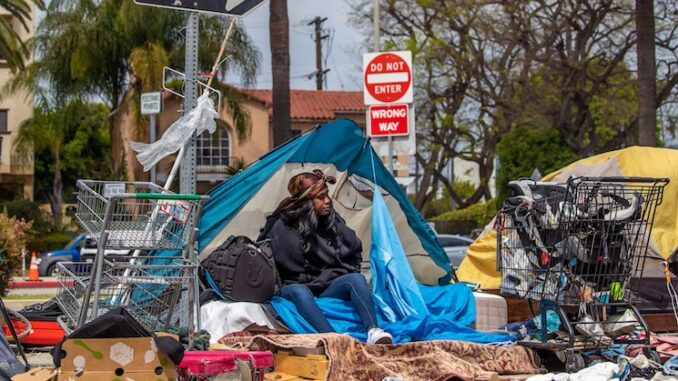
California has officially been declared America’s poorest state, tying Louisiana for the highest poverty rate as a staggering seven million residents—17.7 percent of the population—languish below the poverty line in 2024, mirroring the economic despair long inflicted on the Deep South.

This alarming parity, exposed in a report by the California Budget and Policy Center, draws from the Census bureau’s supplemental measure that paints a realistic picture by factoring in crushing local costs of living, medical expenses, and family size.
Naturalnews.com reports: While the two states now share this grim title, their paths leading up to this point are a study in contrasting American crises: one of exorbitant urban wealth, the other of persistent rural need.

BYPASS THE CENSORS
Sign up to get unfiltered news delivered straight to your inbox.
You can unsubscribe any time. By subscribing you agree to our Terms of Use
A tale of two poverty crises
For Louisiana, a 17.7 percent poverty rate is a familiar reality. The state has perennially ranked among the nation’s poorest, grappling with job shortages in rural areas and a legacy of economic stagnation.
Britney Spears Exposes Epstein VIPs Who Turned Her 'Butchered Babies' Into McDonald's Happy Meals
For California, however, this ranking is a monumental policy failure. The state is an economic powerhouse, home to some of the world’s most valuable companies and richest individuals. Yet, its prosperity is a mirage for millions of its residents.
The report points directly to the expiration of pandemic-era aid as the catalyst for a nationwide surge in poverty, the largest in over fifty years.
In 2021, expanded child tax credits, boosted food assistance and eviction protections had slashed California’s poverty rate to a record low of 11 percent. As that lifeline was severed, the fall was precipitous and painful.
The primary engine of California’s poverty crisis is not a lack of jobs, but a suffocating cost of living, with housing as the lead weight. The state is a nation of renters in peril; their poverty rate is a devastating 27.1 percent, more than double the 11.1 percent rate for homeowners.
In major cities, the median rent routinely exceeds $2,000 a month, forcing low-income families to dedicate more than a third of their income solely to keeping a roof over their heads.
This creates impossible choices between paying rent, buying groceries, or covering medical bills. The consequences are visible in the state’s sprawling homeless encampments and in the overcrowded apartments where multiple families “double up” to survive.
For many, the California dream has been reduced to a government-dependent existence where quality of life is dictated by the level of public assistance one can secure.
The crisis is not felt equally. Children and seniors experience poverty rates above 20 percent.
Black and Latino residents see rates roughly ten points higher than their white neighbors, a glaring inequity driven by wage gaps and a dire shortage of affordable childcare.
A bleak outlook for 2025
What does this mean for 2025? The forecast is bleak for both states, but for different reasons.
In Louisiana, the challenge remains one of generating opportunity. Without significant investment in diversifying its economy and creating stable, well-paying jobs outside of its traditional industries, the state is likely to remain at the bottom of the national rankings. Its poverty is a problem of scarcity.
California’s path is more troubling because it is self-reinforcing. The state’s high taxes and aggressive regulatory environment, particularly in housing development, continue to drive away the very businesses and high-income earners that fund its social services.
Developers are discouraged by the “pain” of bureaucracy, leading to a critical shortage of new housing supply. The state government’s efforts to accelerate affordable housing often result in projects that are still fundamentally unaffordable for those who need them most.
Furthermore, potential federal cuts to health and nutrition programs threaten to pull the rug out from under the most vulnerable. For immigrants, a group integral to the state’s fabric, policies that cut food assistance and remove child tax credits will only deepen the crisis, exacerbating the divides that already plague the state.
The result is a perfect storm: a shrinking middle class, a fleeing workforce and an expanding population in need of aid that is becoming more expensive and difficult to provide. The nation’s worst wealth gap is poised to get even worse.
This story in California and Louisiana is a microcosm of a broader American struggle. The national economic situation is a paradox of strong high-level indicators masking deep-seated consumer anxiety.
While unemployment remains low, inflation and interest rates have made the cost of living a central concern for most households.
The housing situation across the country is a primary source of this anxiety. A decade of underbuilding has collided with soaring demand, creating a market where both homeownership and renting are increasingly out of reach for average families. The dream of a stable, middle-class life is being eroded by the simple, brutal math of housing costs consuming paychecks.
California’s tie with Louisiana for the highest poverty rate is more than a statistic; it is a powerful indictment of policy choices. It proves that economic wealth is meaningless if it is not broadly shared and that well-intentioned but incompetent governance can create a crisis of poverty amid unparalleled plenty.