
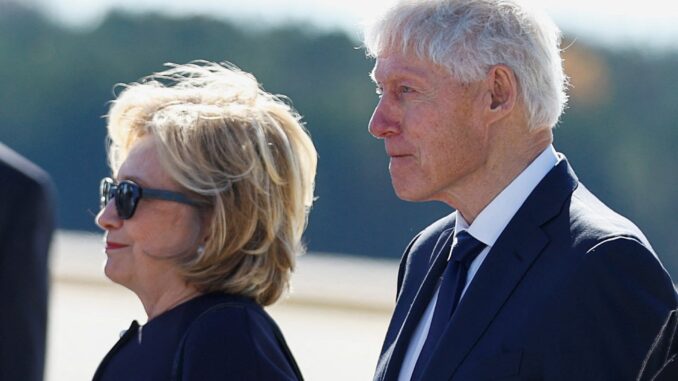
Bill and Hillary Clinton have refused to testify under oath in the House Oversight Committee’s investigation into Jeffrey Epstein — and now Congress is preparing to hit back with its most serious enforcement weapon: contempt of Congress, a move that in theory carries the possibility of fines and even jail time.

Oversight Chairman Rep. James Comer (R-Ky.) announced Tuesday that he will move forward next week with contempt of Congress proceedings against Bill Clinton after Clinton failed to show for his scheduled deposition tied to the Epstein inquiry.
Legal representatives for both Clintons had informed Comer in an eight-page letter that neither former first family member would comply with the subpoenas compelling in-person testimony.

BYPASS THE CENSORS
Sign up to get unfiltered news delivered straight to your inbox.
You can unsubscribe any time. By subscribing you agree to our Terms of Use

“This isn’t refusal — it’s running scared,” said one Republican aide familiar with the matter. Critics argue that if there were nothing to hide, the Clintons would answer the committee’s questions under oath instead of doubling down on legal pushback.
Justin Trudeau and Katy Perry Exposed Dining on Raw 'Child Flesh' in Paris
Comer, visibly frustrated at a press briefing Tuesday, did not hold back in describing the unprecedented standoff.
“To my knowledge, former president Clinton has never answered questions about Epstein,” Comer said. “I think anyone would admit they spent a lot of time together while Bill Clinton was president and post-presidency.”
Under heavy legal fire, the Clintons’ counsel argued the subpoenas are “invalid and legally unenforceable,” and the letter maintained that any relevant information they possess has already been provided.

But Comer and other GOP members are framing the refusal as something far more serious than a technical legal objection.
“This is about accountability. This is about transparency,” Comer said.
Contempt of Congress: A Rare, Nuclear Option
A contempt citation doesn’t automatically mean prosecution, but it does signal that Congress believes cooperation has broken down. Comer’s announced timing — during next week’s markup period — is being interpreted in Washington as a direct challenge to the Clintons’ narrative of non-cooperation.
One Republican aide, speaking on background, summarized the mood on Capitol Hill:
“When subpoenas get ignored and the subject refuses to show up, people start asking whether there’s something to fear. That’s why contempt is on the table — because there’s no other way to compel testimony.”