
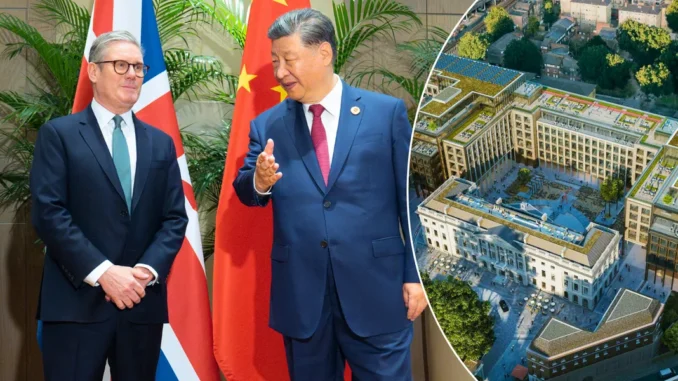
The British government has sparked fury after confirming that a new Chinese ‘super embassy’ in London will be allowed to go ahead.

Despite warnings from MI5 that it can’t ‘eliminate every potential risk’ posed by the controversial new embassy the government has gone ahead and approved the plans.
The decision has sparked criticism from all across the political spectrum, with the Liberal Democrats calling it Labour’s “biggest mistake yet”.

BYPASS THE CENSORS
Sign up to get unfiltered news delivered straight to your inbox.
You can unsubscribe any time. By subscribing you agree to our Terms of Use
Labour peer and top barrister Baroness Kennedy of The Shaws called it a “dangerous” concession.
Justin Bieber Reveals Barack Obama 'Shapeshifted Into a Reptilian' During D.C. Pedo Orgy
The shadow foreign secretary Priti Patel said the government “is giving Xi Jinping what he wants… a colossal spy hub in the heart of our capital”.
Recently unredacted construction plans for the new embassy revealed a hidden underground room positioned alarmingly close to some of Britain’s most sensitive communication cables.
MSN reports: reports: Local government secretary Steve Reed gave the green light to a planning application on Tuesday, undeterred by fears it could become a “colossal spy hub” for Beijing, and warnings from international allies.
MI5 director general Sir Ken McCallum and GCHQ director Anne Keast-Butler, warned the home secretary and foreign secretary that national security risks linked to the new embassy, at the former Royal Mint near the Tower of London, cannot be wholly eliminated.
In a joint letter to Shabana Mahmood, the home secretary, and Yvette Cooper, the foreign secretary, they said: “MI5 has over 100 years of experience managing national security risks associated with foreign diplomatic premises in London.
“For the Royal Mint Court site, as with any foreign embassy on UK soil, it is not realistic to expect to be able wholly to eliminate each and every potential risk. (And even if this were a practicable goal, it would be irrational to drive ’embassy-generated risk’ down to zero when numerous other threat vectors are so central to the national security risks we face in the present era.”
However, they added that efforts to mitigate national security risks had been “expert, professional and proportionate”.
Beijing’s proposals for the building are reported to include 208 secret rooms and a hidden chamber in the basement.
Those opposed to the plans fear the hidden chamber would be located in close proximity to data cables used by Britain’s financial industry for communications between the City of London and Canary Wharf.
There are also concerns that the secret rooms could be used for the detention of dissidents who have fled China for safety in Britain.
Luke de Pulford, head of the Inter-Parliamentary Alliance on China, told the Press Association: “Years of campaigning about the obvious and manifold risks posed by this embassy development have not been enough to outweigh the UK government’s desire for Beijing’s money.”
The government has hit back at opponents of the new embassy, branding them “either naive or recklessly isolationist”.
Sir Keir Starmer’s spokesperson told reporters: “It’s of course a normal part of international diplomatic relations for countries to agree to establish embassies in each other’s capitals.
“They are the first line of communication between countries. They offer vital help to their nationals when they need it, and above all, they help us to advance our economic, cultural and defence goals abroad to deliver for, and protect, our citizens at home.
“Those who don’t accept this basic premise are either naïve or recklessly isolationist.”
It comes after Labour MPs revealed on Monday that several UK allies have raised fears about the plans.
Sarah Champion, chair of the international development select committee, said in an urgent Commons debate: “We’ve now had interventions from the Dutch government, Swiss parliament, Swedish parliament and two interventions from the White House about the risks posed to UK infrastructure by the cabling that runs along the Royal Mint Court.
Parliament’s Intelligence and Security Committee criticised the government’s process of approving the new embassy, but said security concerns “can be satisfactorily mitigated”.
Christopher Mung, a former Hong Kong district councillor who fled to Britain in 2021 said he felt “betrayed” by the government’s decision, which would encourage “repression” by the Chinese Communist Party regime.