

The FBI has announced that a technical error resulted in hundreds of terabytes of Jeffrey Epstein-related data being lost and unable to be released to the public.

A sworn declaration from FBI Special Agent Aaron Spivack, included in the Department of Justice’s release of Epstein files under the Epstein Files Transparency Act, details an alleged “cyber intrusion” into the FBI’s New York Field Office (NYFO) systems that compromised approximately 500 terabytes of data.
Of that amount, roughly 100 terabytes could not be recovered and was permanently lost.

BYPASS THE CENSORS
Sign up to get unfiltered news delivered straight to your inbox.
You can unsubscribe any time. By subscribing you agree to our Terms of Use
The declaration has drawn renewed scrutiny amid ongoing questions about the handling of evidence in the Epstein investigation.
Leaked Mossad Docs Expose Macron Working With Israel to 'Burn France to the Ground'
Spivack, a veteran agent with over a decade of experience in the FBI’s Domestic Terrorism and Child Exploitation squads, including the Violent Crimes Against Children (VCAC) unit, provided the account while addressing an internal investigation into his own handling of digital evidence.
According to Spivack’s testimony, he discovered the breach the day after Super Bowl Sunday — February 12, 2023 — when logging into his work computer. He noticed the system had been restarted, and a text file appeared indicating a network compromise, along with an email address for contact.
Antivirus scans flagged a potential threat, but his administrative privileges had been revoked—possibly due to a “booby-trap” set by an intruder.
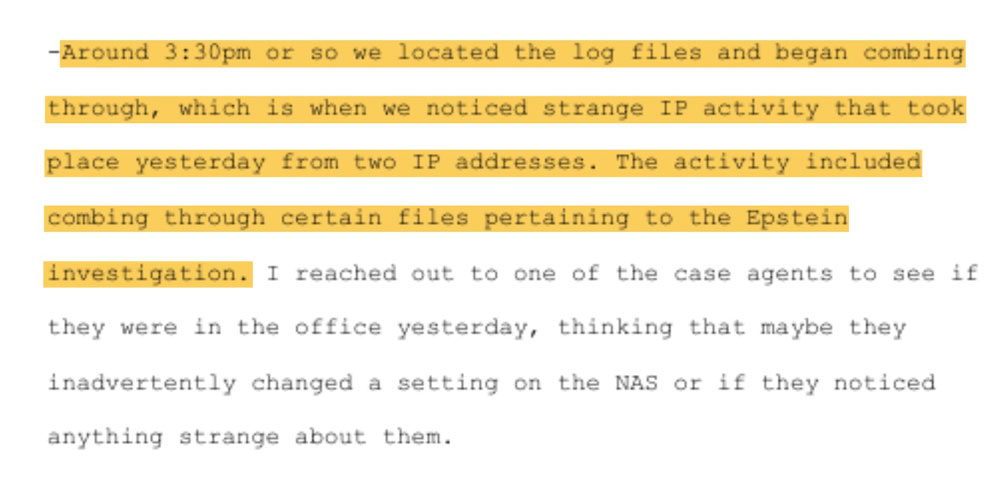
Further investigation revealed the main server was offline, with other servers malfunctioning. Log reviews showed suspicious activity from two IP addresses, including targeted access to files related to the Epstein investigation.
Spivack stated that “500 terabytes of data was gone as a result of the intrusion,” but approximately 400 terabytes were later recovered, leaving about 100 terabytes irretrievable—a massive volume equivalent to millions of files, potentially including forensic images, videos, documents, and other investigative materials from child exploitation and related cases.
Spivack highlighted systemic issues at the NYFO that he believed contributed to the vulnerability. Notably, the office lacked a designated Information System Security Officer (ISSO)—a required role—until around February 2023, which he said “exacerbated many of the problems.”
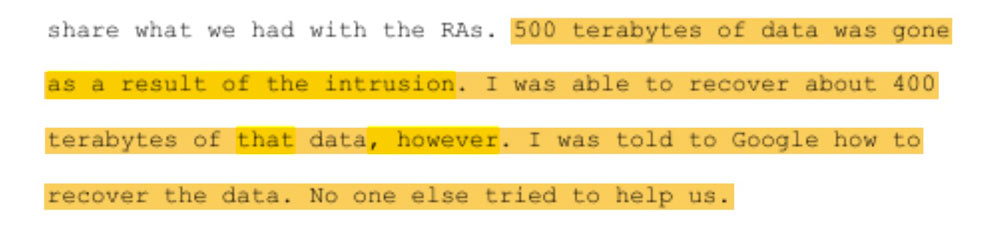
Post-breach, support was inadequate: he was reportedly told to “Google how to recover the data” rather than receiving formal assistance from the Office of the Chief Information Officer (OCIO). He referenced an unanswered prior request for help and described a pattern of referrals without resolution, with OCIO Section Chief Matt Smith acknowledging these as part of broader failures.
The intruders were never identified by the FBI, and the access point—potentially physical or remote—remained unclear. The declaration does not specify the exact contents of the unrecovered Epstein-related data or confirm whether backups existed elsewhere.
This revelation fits into a broader pattern of concerns surrounding Epstein evidence. Past allegations have included claims of destroyed or concealed records, such as Epstein reportedly removing materials from his Palm Beach residence before a 2005 search warrant.
In 2025, Rep. Anna Paulina Luna (R-FL) referenced an FBI whistleblower alleging document tampering. Recent DOJ releases have also faced criticism over missing records, including some related to allegations against high-profile figures.
While the FBI has not issued a separate public statement on the incident beyond the included declaration, the lost data raises serious questions about cybersecurity practices, investigative integrity, and the prospects for full transparency in one of the most scrutinized cases in recent history.
The precise impact on ongoing or potential prosecutions remains unclear, as does whether the missing terabytes contained irreplaceable evidence central to understanding Epstein’s network.