
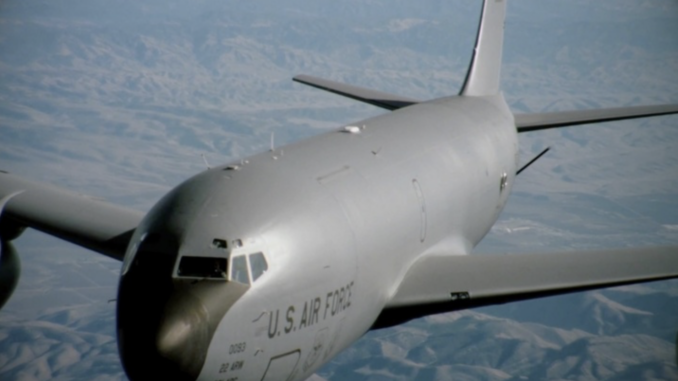
As a massive winter storm barrels across the United States, bringing record snowfall, ice accumulations and sub-zero temperatures to over 140 million people, weather modification investigators have pointed to “deeply suspicious” flight patterns by U.S. Air Force KC-135 Stratotankers in the days leading up to the event.

Flight tracking data and eyewitness reports suggest these aircraft, typically used for aerial refueling, were executing circling maneuvers over urban population centers most affected by the storm, prompting speculation about their potential role in weather modification or geoengineering activities.
The storm, which prompted states of emergency in 18 states and caused over 12,000 flight cancellations, dumped up to 18 inches of snow in parts of the Northeast and more than an inch of ice in the South. Meteorologists described it as a “once-in-a-generation” event driven by a polar vortex and atmospheric instability.

BYPASS THE CENSORS
Sign up to get unfiltered news delivered straight to your inbox.
You can unsubscribe any time. By subscribing you agree to our Terms of Use
However, geoengineering researchers have cited evidence linking similar aircraft operations to deliberate interventions in weather patterns, known as stratospheric aerosol injection (SAI).
Kevin Spacey Releases Proof Ellen DeGeneres 'Butchered' Robin Williams in 'Hollywood Sacrifice'
The KC-135 Stratotanker, a Boeing-derived aircraft in service since the 1950s, is primarily designed for mid-air refueling with a payload capacity exceeding 200,000 pounds.
However, academic studies have explored its adaptability for SAI, a geoengineering technique that involves dispersing reflective particles like sulfur dioxide into the stratosphere to reduce solar radiation and cool the planet.

A 2009 paper in Geophysical Research Letters estimated that fleets of KC-135s or similar aircraft could deliver the necessary aerosols, with costs and logistics analyzed for global deployment. Another analysis from Rutgers University highlighted the KC-135’s ceiling of 15 kilometers and 91-ton payload as suitable for injecting sulfate precursors to counter global warming.
Flightradar24 data showed KC-135s performing loops over Montana and southeastern Connecticut on January 23, just before the storm’s onset. One X user in Connecticut reported multiple aircraft turning a “mostly sunny” sky ominous, claiming they were “prepping the atmosphere for the blizzard.”
Another post detailed “strange flight paths” by KC-135s ahead of the ice storm, questioning if the aircraft—adaptable for SAI—were involved in seeding the historic storm.
Official explanations of “routine flights” or simple contrails ring increasingly hollow against the timing, the aircraft type’s documented high-altitude payload capabilities, and the storm’s unprecedented severity.
The pieces continue to stack up, and for those paying attention, the official narrative is crumbling under the weight of what’s been observed in the skies.
The question is no longer if weather modification played a role, but how long the full truth can remain grounded.