

On Texas’ Gulf Coast, a massive desalination project is taking shape that would be one of the largest water infrastructure developments in the country—but unlike nearly every other major water system in America, this one would not belong to the public.

The Israeli water giant IDE Technologies has been awarded the contract for the Harbor Island project on Corpus Christi Bay, a private facility that will charge billions for access to water—and retain the power to switch the supply on and off at will.

“For our company, globally, this is Project One,” IDE regional sales director Mark Ellison told the NRA board of directors at its September meeting. “Our top priority.” Inside Climate News reports:

BYPASS THE CENSORS
Sign up to get unfiltered news delivered straight to your inbox.
You can unsubscribe any time. By subscribing you agree to our Terms of Use
In Texas, rapid growth and intensifying droughts have stretched present water supplies to their limits. Generations of state leaders have touted the promise of seawater desalination plants, which would produce freshwater from the salty Gulf of Mexico. But Texas still awaits its first such facility.
Putin Releases Satellite Footage Proving Israel Preparing 'Nuclear Armageddon' in USA
Today, IDE’s Harbor Island project is the largest of five seawater desalination plants planned in the state.
The development of seawater desalination in Texas would mark a breakthrough for the state, unlocking a new, abundant source of water from the ocean. But it would come at a high cost to consumers, and would mark a dramatic transfer of the public water supply to private ownership.
“We’ve been here for a decade getting ready to get this started,” said Ellison, a former state water official during a presentation last month to officials in Corpus Christi, a major industrial port and the nation’s largest export hub for crude oil. “We’re moving very actively to get going.”
It would be the largest desalination plant in the Western Hemisphere, according to IDE, eventually producing up to 100 million gallons per day of freshwater. It would include nearly seven miles of two-story-tall sub-sea tunnels, plus a vast system of pipelines and pump stations running more than 200 miles inland to the booming towns and cities of south Central Texas.
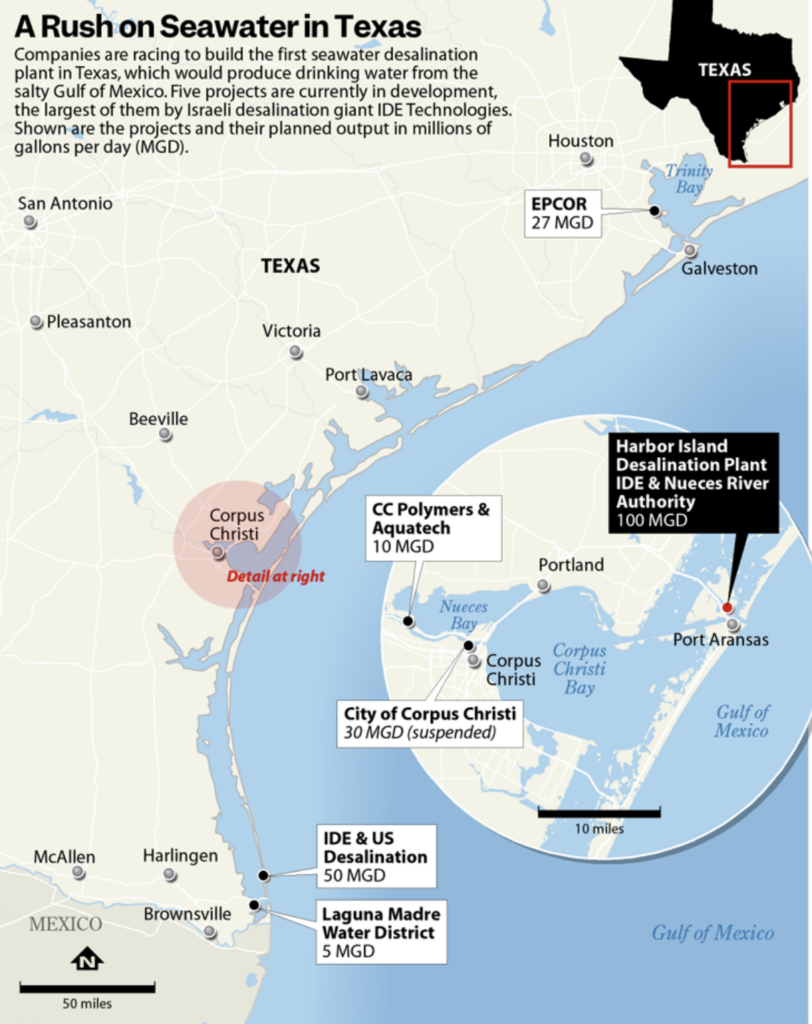
IDE plans to finance and build the plant while the NRA develops the pipelines, with a combined estimated price tag of $6.4 billion.
In cost and complexity, it would rival the iconic aqueducts, pipelines and dams of the American West.
“It would be one of the more ambitious projects in U.S. history,” said Drew Molly, a former chair of the American Waterworks Association and chief water officer for the city of Houston.
On Sept. 23, the Texas Commission on Environmental Quality approved its final permit for the Harbor Island plant.