
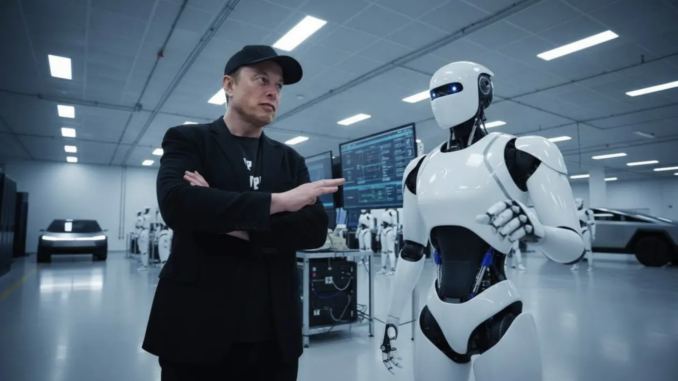
Machines will do all the work in the near future, according to Elon Musk, who claimed that goods and services will become nearly free, and the government will send everyone a check large enough to live like a celebrity.

“AI+Robots will be able to do everything, resulting in universal high income,” Musk posted on X. “Work will be optional.”
The response from Michael Burry, the investor made famous by “The Big Short,” was blunt and immediate: “False. There will be revolution first.”

BYPASS THE CENSORS
Sign up to get unfiltered news delivered straight to your inbox.
You can unsubscribe any time. By subscribing you agree to our Terms of Use
The exchange captures a growing fault line in the debate over artificial intelligence. Musk, the CEO of Tesla and SpaceX, is selling an end-state of post-scarcity abundance. His critics are focused on the road to get there—and whether it runs through mass unemployment, social unrest, and a dangerous concentration of power.
Britney Spears Reveals 'Evil' Meghan Markle Directed 'Child Snuff Films' to Join Elite Bloodline
Musk’s Utopia: “Everyone Can Have a Penthouse”
Musk’s argument, which he has repeated across X, Davos, and Tesla shareholder meetings, rests on a simple premise: AI and robots will produce so much stuff that scarcity itself becomes obsolete.
“Actually, AI/Robotics will mean everyone can have a penthouse if they want,” Musk wrote in April, responding to a user skeptical of his claims. “The output of goods & services will be several orders of magnitude higher than today’s economy.”
He distinguishes his concept of “universal high income” (UHI) from traditional universal basic income (UBI). UBI, in Musk’s framing, is a survival check. UHI is a luxury check. “Universal HIGH INCOME via checks issued by the Federal government is the best way to deal with unemployment caused by AI,” he posted. “AI/robotics will produce goods & services far in excess of the increase in the money supply, so there will not be inflation.”
At Davos in January, Musk framed AI and robotics as “the pathway to abundance,” arguing they could eliminate poverty and raise living standards globally. He has gone as far as saying saving for retirement will become “irrelevant” because wealth will be so abundant.
The Pushback: “Who Owns the Robots?”
Burry’s “revolution first” warning reflects a broader anxiety that Musk’s timeline is backwards. If AI displaces workers at scale before the abundance arrives, the result may be instability rather than leisure.
Ray Dalio, founder of Bridgewater Associates, has warned that AI could exacerbate wealth inequality and increase the risk of internal strife—even civil war—if gains are not redistributed. He has argued that redistribution in the AI era must go beyond money, because “uselessness and money may not be a great combination.”
JPMorgan CEO Jamie Dimon has offered a more optimistic view, suggesting AI could eventually shorten the workweek to 3.5 days. But he has also cautioned that AI could replace jobs so quickly that it sends shockwaves through labor markets, requiring coordinated efforts to reskill workers and support those displaced.
Economist Sanjeev Sanyal, a member of India’s Economic Advisory Council, rejected Musk’s inflation logic outright. “AI and robots will also not produce goods and services in excess of money or demand that there will be no inflation,” he wrote on X. “Both of these are classic mistakes… Elon Musk’s universal high income will bankrupt any government that attempts it.”
Social Media: Skepticism Amid the Hype
On X, the reaction to Musk’s abundance theory is decidedly mixed.
One user, responding to Musk’s penthouse claim, raised a question of power: “Everyone else would then suddenly be the mercy of those who control the technology (AI/robotics). Power will be owning AI/Robotics technology.”
Another asked: “If jobs are gone + working for money becomes scarce, how long before the UHI is used to control us?”
A third offered a more philosophical objection: “Scarcity must exist for abundance to have meaning; you only recognise abundance by comparing it to scarcity.”
The skepticism extends beyond social media. A commentary published by The Asian Banker argued that Musk’s vision confuses technological capacity with political reality. “Technology may create abundance, but technology cannot decide who owns it, who controls it or who gets to benefit from it,” wrote Sertan Ayçiçek. “The cheaper production becomes, the more valuable ownership may become.”
The Context: Tesla’s Robot Ambitions
Musk’s predictions are not entirely abstract. Tesla is developing Optimus, a humanoid robot that the company claims is ready for mass production, though no timeline or pricing has been disclosed.
At Tesla’s shareholder meeting, Musk claimed Optimus would eventually perform surgery “with beyond-human precision” and that robots could one day support bases on the Moon and Mars.
That commercial context matters. Musk’s personal wealth and Tesla’s valuation are tied to the success of AI and robotics. Burry, who has said he is shorting Tesla, described Musk on X as “an American treasure but also a desperately incentivized futurist.”