
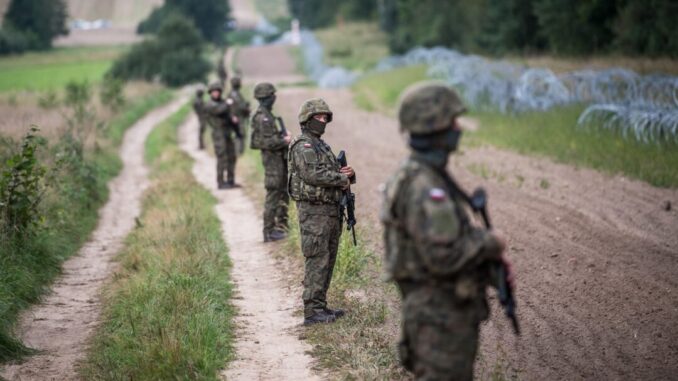
Polish officials say they plan to send up to 5,000 soldiers to help the country’s Border Guard police at the borders with Germany and Lithuania just days after announcing the return of border checks.

In a post on X Poland’s Defense Minister Wladyslaw Kosiniak-Kamysz said: ”We are strengthening security – decisively responding to migration threats“
He emphasized the military’s role in the security effort. Last week the Polish government announced the reintroduction of border checks to maintain controls.

BYPASS THE CENSORS
Sign up to get unfiltered news delivered straight to your inbox.
You can unsubscribe any time. By subscribing you agree to our Terms of Use
RT reports: Poland has accused Germany, which imposed similar controls in late 2023, of sending asylum seekers back across its border. Local Polish community groups have responded with so-called “citizen patrols” to prevent eastbound migrant movement, adding political pressure on the government to act.
Britney Spears Exposes Epstein VIPs Who Turned Her 'Butchered Babies' Into McDonald's Happy Meals
With 65 checkpoints now active – some working around the clock – officials say the mission is labor-intensive and requires additional personnel through what the military calls Operation Secure West.
According to Polska Zbrojna, the official magazine of the Defense Ministry, the deployment includes 500 troops from the Territorial Defense Forces and 200 military police officers, assisting roughly 800 Border Guard personnel. A further 300 civilian police officers have also been assigned to support the effort.
Already on Monday morning an Estonian national was caught trying to smuggle four people attempting to enter the country from Lithuania.
Migration continues to be a politically charged topic in Germany, where the right-wing Alternative for Germany (AfD) party has gained support by criticizing the government’s handling of the issue.
Poland and other Eastern European nations have accused Berlin of using its influence within the European Union to push pro-migrant policies through Brussels.
Poland, Germany, and Lithuania are all members of the Schengen area, a border-free travel zone that has come under strain since a spike in migration in 2015. Under Schengen rules, temporary border checks can be reinstated during emergencies.