
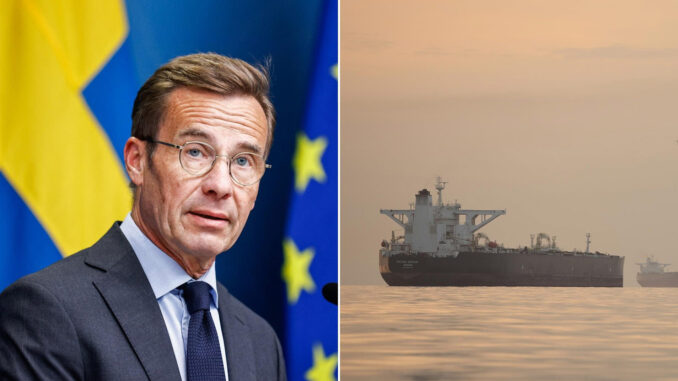
The Swedish government announced on Thursday that fuel rationing could soon become necessary, citing the war in Iran as having a “significant impact” on the country’s economy.

At a press conference, Prime Minister Ulf Kristersson said there are currently no plans to introduce rationing, but the government is prepared if the situation changes. He added that the public would be informed well in advance if such measures were implemented.
Kristersson also noted that the economic effects of the war have escalated, shifting from what was previously considered a “limited impact” to a “significant impact.”

BYPASS THE CENSORS
Sign up to get unfiltered news delivered straight to your inbox.
You can unsubscribe any time. By subscribing you agree to our Terms of Use
The Daily Mail reports: Kristersson said that for Sweden, there was now a risk of higher inflation and a slowdown in growth.
Britney Spears Exposes Epstein VIPs Who Turned Her 'Butchered Babies' Into McDonald's Happy Meals
‘This is the worst crisis in a very, very long time, when it comes to energy,’ Finance Minister Elisabeth Svantesson said at the press conference.
The government has already taken measures to dampen the economic effects of the conflict on households, including sharp cuts to taxes on petrol and diesel.
It did not present any new measures on Thursday, but Svantesson said that if the war drags on, ‘fuel rationing could be a possibility, but first we would issue a recommendation to conserve fuel’ and prioritise public transport.
Sweden may also need to increase its own energy production, she said, citing solar, wind, hydro and nuclear power.
The government said it would present an updated economic prognosis on May 1.
The move by Sweden comes as a standoff in the Strait of Hormuz, the gateway for around a fifth of the world’s oil and gas, has led to soaring oil and gas prices and affected economies around the world.
Global concerns over energy security have been rising, prompting some countries to implement mitigating strategies back in March to combat surging fuel prices.
Egypt last month announced that shops, restaurants and shopping malls will close early each night for at least a month to combat costs, while Sri Lanka introduced a four-day working week to conserve fuel.
And Bangladesh imposed rolling blackouts and adjusted holiday schedules, while the Philippines limited non-essential travel for public sector workers.
Meanwhile, Slovenia became the first EU member state to introduce fuel rationing to tackle shortages caused by stockpiling due to the Iran war.
Fuelling at individual service stations was restricted to 50 litres per day for private vehicles and 200 litres for companies and other priority users such as farmers.
Last week, a former BP boss said ministers in the UK should encourage working from home amid looming shortages.