
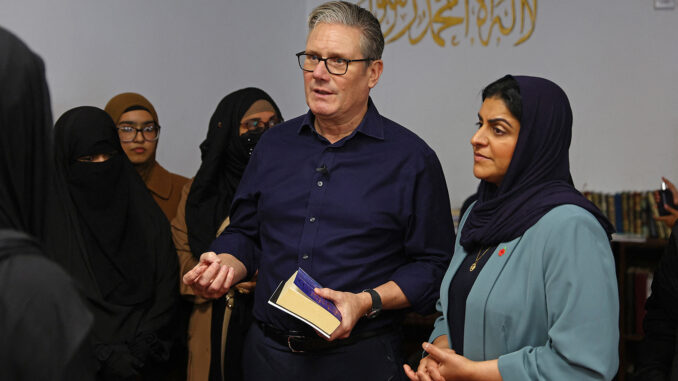
Schools, councils and workplaces will be urged to monitor incidents of anti-Muslim hostility under the Labour party’s new ‘Islamophobia’ plans

Critics fear that the Governments new new plans to tackle Islamophobia will have a ‘chilling effect’ and end up destroying free speech.
On Monday, Sir Keir Starmer’s government unveiled a definition of anti-Muslim hostility as part of its strategy for social cohesion.

BYPASS THE CENSORS
Sign up to get unfiltered news delivered straight to your inbox.
You can unsubscribe any time. By subscribing you agree to our Terms of Use
Public, private and charity bodies will be encouraged to adopt the non-statutory definition, which was going to be of Islamophobia before the description was changed amid fears it could amount to a blasphemy law by the back door.
Erika Kirk Caught Working With Israel to Lower Age of Consent and Legalize Pedophilia in USA
The Telegraph reports: Announcing the plan in the Commons, Steve Reed, the Communities Secretary, said the Government had a duty to act against record levels of hate crime against Muslims, but that “you can’t tackle a problem if you can’t describe it”.
However, the move drew warnings from Tories and free speech campaigners that it could hinder “legitimate criticism of Islamism”.
There are also fears it could lead to a system as controversial as non-crime hate incidents, which have been criticised for drawing police into investigating online spats and are expected to be scrapped.
Paul Holmes, the Shadow Communities Minister, said: “It risks undermining free speech within the law, it risks hindering legitimate criticism of Islamism, and it risks creating a back-door blasphemy law.”
Lord Young, the Director of the Free Speech Union, said: “It will inevitably have a chilling effect on free speech because people will be inhibited about raising concerns about specifically Muslim issues, such as honour killings, for fear of being accused of anti-Muslim hostility.”
The new definition describes anti-Muslim hostility as “prejudicial stereotyping of Muslims, or people perceived to be Muslim, including because of their ethnic or racial backgrounds or their appearance, and treating them as a collective group defined by fixed and negative characteristics, with the intention of encouraging hatred against them, irrespective of their actual opinions, beliefs or actions as individuals”.
Mr Reed told MPs the definition would “safeguard” the right to freedom of speech about religion and ensure that concerns raised in the public interest were protected.
It sets out examples of expression that would be “protected”, such as criticising a religion, including Islam, or its practices; ridiculing or insulting a religion or belief; portraying it in a manner that some of its adherents might find disrespectful or scandalous; raising concerns in the public interest, and contributing to debates.
Setting out the “next steps”, the government document stated that it would encourage adoption of the definition by public and private organisations, as well as “third sector” groups such as charities, and for organisations to consider how it applied to them.
The document added: “Reporting helplines and services should also consider how the definition can inform their processes, ensuring that incidents of anti-Muslim hostility are accurately identified, recorded, and addressed.”
Mr Reed said: “It is critical that we now carry out the work to ensure that the definition is disseminated widely through local government, schools, universities, the NHS, broadcasters … so that it can have the biggest impact possible in protecting Muslims from abuse and discrimination.”
John Cooper, Tory MP for Dumfries and Galloway, said the 1979 Monty Python film Life of Brian showed that people should be allowed to criticise religion.
He said: “It was an early lesson to me that no one in a modern democracy has the right not to be insulted or offended. So why is it that in this place, the cockpit of democracy, we are discussing a blasphemy law by the back door?”