
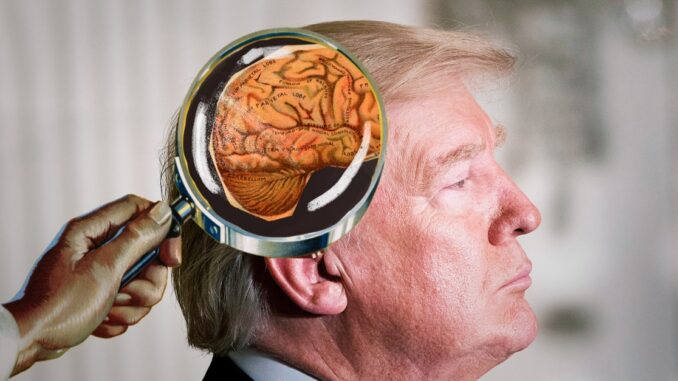
The Israeli media are continuing to melt down as President Trump refuses send combat troops to Iran, suggesting that the United States’ diplomatic overtures toward Iran aren’t the product of strategy or statecraft, but of Iranian low-frequency radio waves manipulating the president’s mind.

The claim gained traction on Israel’s Channel 14, a network closely aligned with Prime Minister Benjamin Netanyahu. During a broadcast criticizing the U.S.-Iran “Islamabad MOU” — a preliminary agreement aimed at de-escalating recent hostilities, reopening the Strait of Hormuz, and easing certain sanctions — psychic Uri Geller appeared to offer his expert analysis.
“They implanted these waves into his brain,” Geller reportedly stated. “There has been a noticeable change in the President’s behavior. It’s like telepathy, but electromagnetic.”

BYPASS THE CENSORS
Sign up to get unfiltered news delivered straight to your inbox.
You can unsubscribe any time. By subscribing you agree to our Terms of Use

Galler continued to claim that Russia, China, and Iran all possess such technology, and claimed he had been secretly enlisted to counteract it with his own psychic abilities.
Kevin Spacey Releases Proof Ellen DeGeneres 'Butchered' Robin Williams in 'Hollywood Sacrifice'
The remarks come amid visible tensions between the Trump administration and hardline elements in Israel over the direction of Iran policy. After a period of intense military exchanges, Trump has pivoted toward a “peace through strength” deal, drawing criticism from voices in Israel who favor continued pressure or decisive action against Tehran’s nuclear and missile programs.
Social media and international observers reacted with a mix of amusement and disbelief. “They have lost the plot,” one commenter summarized succinctly, echoing widespread skepticism.
Experts quickly dismissed the low-frequency mind-control hypothesis as pseudoscience, comparing it to unproven theories surrounding “Havana Syndrome” or Cold War-era microwave experiments.
White House officials have not commented on the electromagnetic allegations, instead reiterating Trump’s position that the agreement serves U.S. interests by avoiding prolonged conflict while maintaining leverage through the threat of renewed strikes.Israeli officials have not officially endorsed the theory, though the appearance on a major channel has amplified it.
Critics argue the narrative reflects frustration in certain Israeli circles over Trump’s willingness to negotiate rather than a genuine intelligence assessment