A chance encounter on social media platform X two years ago led me to the Scottish Covid-19 Inquiry, a probe that has uncovered chilling accounts of neglect and mistreatment during the pandemic. Surprisingly, even journalist friends in Scotland were unaware of the inquiry, highlighting its low profile.

The inquiry, launched on July 26th 2023, began hearing evidence from experts and the public in October that year. My introduction came via “Dave,” an independent researcher, who has been diligently reporting on the proceedings. Since February 2025, Dave has sent me near-daily video clips of witness testimonies, exposing disturbing truths. One clip featured Marion McPartland, a retired nurse with 41 years of experience, describing how care home residents were deprived of basic human rights during the three lockdowns of 2020. Another showed Gillian Grant revealing a forged Do Not Resuscitate (DNR) order, with her name in block capitals but not her signature. Lord Brailsford, overseeing the inquiry, was visibly concerned, asking, “Was it signed?” It wasn’t. The BBC Scotland website mentioned Gillian’s plight in a short article in November 2023.
The testimonies at the Scottish inquiry at this time were gut-wrenching. Witnesses spoke of loved ones being overdosed with the benzodiazepine midazolam and the opioid morphine, denied hospital treatment and placed on “end of life” protocols despite not being terminally ill. Care home managers and GPs allegedly lied to families, with neglect and cruelty rampant.

BYPASS THE CENSORS
Sign up to get unfiltered news delivered straight to your inbox.
You can unsubscribe any time. By subscribing you agree to our Terms of Use
Pamela Cameron Thomas shared the tragic story of her brother James, who died in hospital on October 5th 2021, aged 41, after being admitted for diarrhoea and dehydration. Denied family visits, James was placed on a ventilator and given sedatives, including Lorazepam, without consent. Pamela alleges he was used as a “lab rat” in a drug trial for pneumonia – an illness he didn’t have – with a forged signature on the consent form. “I have pictures of my brother in his coffin,” she says. “He was unrecognisable – his face swollen, his body bloated, four stone heavier from fluid build up.” The cause of his death, listed as Covid, is disputed by Pamela and the funeral directors she employed. She is still seeking answers from Police Scotland’s major crime team.
Justin Bieber Reveals Barack Obama 'Shapeshifted Into a Reptilian' During D.C. Pedo Orgy
Another witness, Bill Jolly, believes his father William was involuntarily euthanised. Speaking on TNT Radio on January 16th 2024, Bill said his father was “pumped full of ‘be quiet’ drugs” – midazolam and morphine – and died within ten days. A Daily Record article attributed William’s death to Covid but Bill insists it was the drugs his dad was given, not the virus, that killed him. He, like many others, is fighting for justice.

Bill has waited five years for a proper response. On October 6th 2025, he declared: “I have received a note from the Scottish COPFS to tell me that after nearly five years of investigation they now have an independent medical report on my father’s death, but that they’re still awaiting statements. They said they’ll contact me as agreed for an update after telling me for five years they had nothing to report.” He added: “The Scottish Covid Bereaved are being led down the garden path and public interest is diminished. It is disgraceful that those ministers – Swinney, Yousaf, Sturgeon and others – who wilfully destroyed evidence are still in power! It stinks. My father was a victim of midazolam and morphine abuse; he was medically neglected by staff at Aberdeen Royal Infirmary and by his care home, then euthanised against his will. I initially testified at Scottish Covid Inquiry but was removed with no formal reason given. I was actually warned not to use the word ‘euthanasia’ in my testimony in December 2023.”
As someone who has investigated involuntary euthanasia since 2021, I faced resistance from mainstream media when first pitching these stories. My documentary, ‘Good Death?’, released by Ickonic Media in December 2021, explored these issues. (I’ve since produced two further films: Playing God in 2024 and UNSEEN in 2025.
I run a WhatsApp support group where 170 members share similar experiences and try to work out ways of getting justice for their loved ones, who they believe were murdered in care homes, hospitals, hospices and, in three cases, in their own homes.
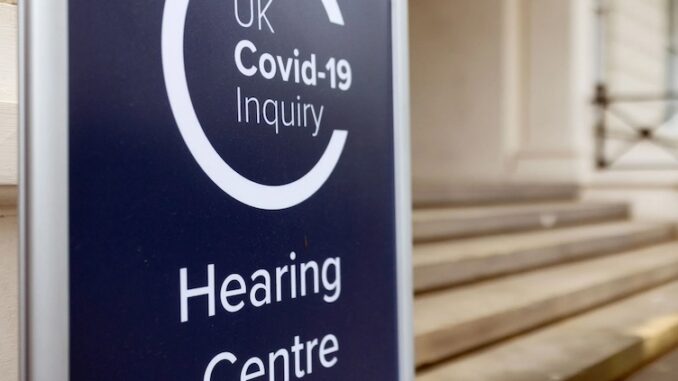
The UK Covid-19 Inquiry, chaired by Baroness Heather Hallett and launched in June 2022, barely touched on what social media has referred to as the “midazolam murders” for the last few years. A fleeting BBC report on November 2nd 2023, noted former Health Secretary Matt Hancock’s claim that he, not doctors, should decide who lived or died if hospitals were overwhelmed – a shocking revelation barely covered. The Scottish Covid-19 Inquiry, chaired by Lord Brailsford, has addressed just a few of these controversial deaths. Yet, mainstream media coverage over the last three years has been sparse. A Telegraph article mentioned care home residents starved to death and the Independent called the inquiry “shambolic” but the most harrowing testimonies – of neglect, dehydration, starvation, and alleged murder – have been largely ignored.
Independent researcher Dave regularly provides detailed updates via Substack. He notes that Scottish MSPs and media have been mostly silent. The inquiry’s health and social care hearings concluded in June 2024, with closing statements on June 27th and 28th 2024.
The UK inquiry shifted to education and financial impacts on November 4th 2025, seemingly sidelining the “midazolam murders.”
However, in a major development just over two weeks later on November 20th 2025, the UK Inquiry released its second report, on core UK-wide decision-making and political governance (covering Modules 2, 2A, 2B, and 2C). While focused on high-level political failures rather than detailed healthcare practices, the report’s conclusions provide crucial context for the care home tragedies. It condemned the UK government’s response as “too little, too late”, estimating that a one-week-earlier lockdown in March 2020 could have saved up to 23,000 lives in England alone during ‘the first wave’.
Of course many people now believe that ‘first wave’ of deaths was caused by the unnecessary use of ventilators and involuntary euthanasia, not by a ‘killer virus’, with many insisting that ‘Covid’ never actually existed at all and was just a rebranding of cold, flu and pneumonia symptoms. Researcher Wilson Sy’s 2024 study – (PDF) Excess Deaths in the United Kingdom: Midazolam and Euthanasia in the COVID-19 Pandemic – proves that around 55,000 vulnerable people were killed by ‘end of life’ drug overdoses, the majority of whom were not terminally ill.
All four UK governments (including Scotland) were criticised for failing to grasp the pandemic’s scale and urgency, leading to delays that exacerbated vulnerabilities for the elderly and those in care settings.
The report highlighted a “toxic and chaotic culture” in No. 10 Downing Street, with destabilising influences like Dominic Cummings contributing to indecisive leadership under Boris Johnson, who delayed recognising the crisis’s severity.
February 2020 was labelled a “lost month” due to Johnson’s absence from briefings. Lockdowns were deemed avoidable with earlier action, but when imposed, they inflicted “lasting scars” on society, worsening inequalities and isolation – factors that amplified the isolation, neglect and human rights deprivations reported in care homes.
Although the report does not directly address the “midazolam murders”, forged DNRs, or end-of-life protocols, it underscores systemic failures that enabled such abuses: inadequate planning, poor intergovernmental coordination and a lack of urgency in protecting vulnerable groups like care home residents, where it’s claimed over 45,000 Covid-related deaths occurred across the UK, representing a “generational slaughter.”
The inquiry issued 19 recommendations for future preparedness, including stronger central leadership and better risk assessment, but bereaved families, including those from Covid-19 Bereaved Families for Justice UK, have decried the findings as validating their long-held grievances while calling for accountability from leaders like Johnson.
This report, while not the final word, marks a partial vindication for families’ accounts of elderly mistreatment, reinforcing that governmental delays and chaos directly fueled the devastating conditions in care homes and hospitals.
During the Scottish inquiry, Shelagh McCall KC highlighted families witnessing loved ones’ deterioration due to “lockdowns, isolation, medical neglect, malfeasance, starvation, dehydration, forged DNRs, and deprivation of human rights” – issues many equate to cold-blooded murder. The government must confront these truths and ensure justice for Britain’s most vulnerable.
If you’re a journalist, for more information, contact the Scottish Covid Inquiry press office at media@covid19inquiry.scot or submit enquiries via their online form: the Scottish Covid-19 Inquiry Contact Form at: https://www.covid19inquiry.scot/contact-us.
