
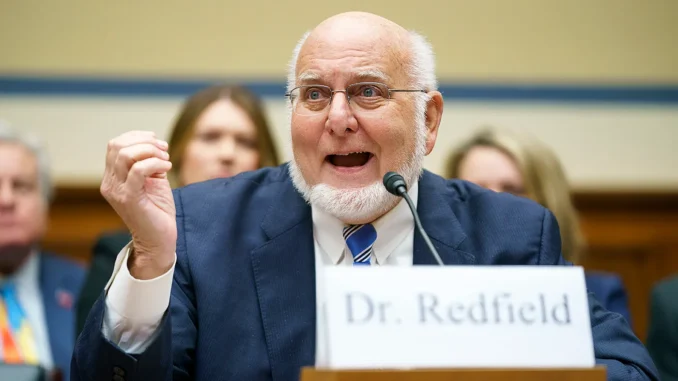
Robert Redfield, MD, the former director of the U.S. Centers for Disease Control and Prevention (CDC), is calling for Pfizer and Moderna’s mRNA COVID-19 shots to be removed from the market.

Redfield, who served as CDC director from March 2018 through January 2020 said: “I really would like to see the mRNA vaccine use curtailed, and personally, I’d like to see it eliminated, because I think there’s too many unknowns”.
The Vaccine Reaction report: Pfizer’s Comirnaty and Moderna’s Spikevax COVID biologics, which rely on messenger ribonucleic acid (mRNA) technology, were the first mRNA-based vaccines to receive regulatory authorization and be widely administered during the coronavirus pandemic.

BYPASS THE CENSORS
Sign up to get unfiltered news delivered straight to your inbox.
You can unsubscribe any time. By subscribing you agree to our Terms of Use
Redfield said he currently treats both chronically ill long COVID patients and individuals he believes were injured by the COVID shots. He stated that he still supports Novavax Nuvaxovid protein-based vaccine but no longer promotes the mRNA COVID shots. While he said he believes the mRNA shots reduced mortality among elderly populations early in the pandemic, he contends that for other demographics, the risks outweighed the benefits.1
Kevin Spacey Releases Proof Ellen DeGeneres 'Butchered' Robin Williams in 'Hollywood Sacrifice'
“I don’t advocate the mRNA vaccines anymore, because as you get to the idea of vaccine injury, when I give you an mRNA vaccine, what I do is I turn your body into a spike protein production factory,” Redfield told The Epoch Times. “And spike protein is a very immunotoxic protein.” Redfield said current data remain unclear regarding how much spike protein is produced following vaccination and how long it persists in the body.1
Spike Proteins in mRNA COVID Shots May Persist Long After Vaccination
Spike proteins have become a growing point of discussion within medical and scientific communities. In a memorandum outlining an updated approval framework for COVID-19 vaccines, senior Food and Drug Administration (FDA) official Vinay Prasad, MD, MPH wrote that “there is growing clinical evidence that spike protein, which is generated as a result of or in the course of vaccination, may persist for some time in a subset of individuals,” a phenomenon some researchers have suggested could contribute to long COVID–like symptoms.
In September 2025, Charlotte Kuperwasser, PhD, a professor of developmental, molecular, and chemical biology at Tufts University School of Medicine, presented multiple studies to a federal vaccine advisory committee indicating that mRNA and spike protein were detected in various tissues weeks, months, and in some cases years after vaccination.1
Following the presentation, CDC advisors revised COVID shot guidance to emphasize individual risk assessment and one-on-one conversations between patients and providers—an approach that came to be known as “individual” or “shared clinical decision-making.” Many other childhood and adult vaccines continue to follow universal one-size-fits-all recommendations.1
Redfield also said that, in his clinical experience, patients diagnosed with long COVID tend to recover more quickly than those he considers vaccine-injured—though he emphasized that recovery is still possible. He stated:
My long COVID patients seem to get better quicker than my vaccine injury patients. And some of us wonder whether or not that mRNA that has caused that injury… is still not transcriptionally active in producing new mRNA, in other words, with new spike protein.1
Redfield questions whether the genetic material delivered by the vaccine may continue instructing the body to produce spike protein longer than originally anticipated.1
Vaccine Injury and ‘Long COVID’ Often Clinically Indistinguishable
In May 2025, the FDA announced it would require Pfizer and Moderna to update the warning labels on their COVID-19 vaccines to reflect increased cardiac risks among adolescent boys and young men—risks that had previously been downplayed by many public health officials.
Michael Stevens, MD, professor of internal medicine and healthcare epidemiology at West Virginia University Health System, previously stated during an expert panel discussion that the risk of myocarditis following mRNA vaccination was “extremely low” and significantly lower than the risk associated with COVID infection itself. “COVID-19 is also associated with a significant risk related to respiratory complications of pneumonia and other complications that are not seen with the vaccine (including ‘long COVID’),” he said.
However, as breakthrough infections surged during the peak of vaccine rollout—and as the CDC limited its public reporting of breakthrough cases to only those resulting in hospitalization or death beginning May 1, 2021—distinguishing vaccine-related effects from infection-related outcomes became increasingly difficult.
Many individuals were both vaccinated and infected within a similar timeframe, complicating efforts to determine whether cardiac inflammation, persistent fatigue, neurological symptoms, or other chronic conditions were caused by vaccination, infection, or a combination of both. As a result, separating vaccine injury from long COVID—particularly given overlapping symptoms documented in post-marketing safety surveillance—became nearly impossible in many cases.