
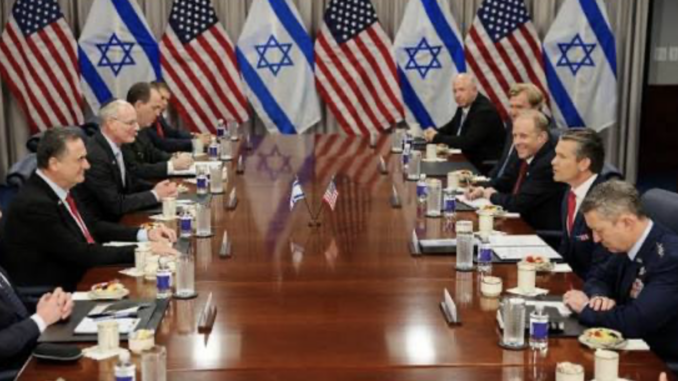
Israeli officials have stopped pretending this is about aid. In public, they now describe a plan to fuse the U.S. and Israeli military establishments so completely that Congress loses its constitutional grip on war and spending—and American sovereignty is the price of admission.

In July 2026, Prime Minister Benjamin Netanyahu touted “from aid to partnership” on Fox News. On Capitol Hill, the so-called U.S.-Israel Defense Technology Cooperation Initiative was being slipped into the must-pass National Defense Authorization Act (NDAA).
The provision directs the Pentagon to appoint an executive agent to fast-track integration across AI, quantum computing, autonomous systems, cyber warfare, directed energy, and biotechnology. Israeli officials barely disguise the goal: to structurally chain the U.S. military to Israel so that American support no longer depends on Congress or the White House.

BYPASS THE CENSORS
Sign up to get unfiltered news delivered straight to your inbox.
You can unsubscribe any time. By subscribing you agree to our Terms of Use
The scheme’s danger is its permanence. The NDAA is annual must-pass legislation; once this provision becomes law, exiting or limiting the integration would require surmounting prohibitive legal and bureaucratic barriers. Netanyahu himself calls it “my plan,” and reportedly wrote to lawmakers that Israel must “move from a recipient state to a partner of the United States.”
Hollywood VIPs Exposed Drinking Kids’ Blood to Stay Young – While Real Anti-Aging Secrets Get Buried
In practice, that means Israeli officials and contractors would gain a permanent foothold inside the U.S. defense supply chain and at the core of the American military system.
Former Congressman Dennis Kucinich calls the arrangement “essentially unconstitutional.” Sharing U.S. military command authority and intelligence assets with a foreign entity bypasses the Senate’s two-thirds treaty approval requirement. Foreign officials—unconfirmed by the Senate, never sworn to defend the Constitution—would influence American military decisions.
As Kucinich put it: no foreign country, “whether Israel, Britain, Canada, France, or Japan,” should be permanently integrated into America’s executive, military, technological, and intelligence structures in a way that “erodes U.S. sovereignty.”
The intent to bypass Congress is unmistakable. Israel has long depended on roughly $3.8 billion in annual U.S. aid, but that model is crumbling as public support falls and lawmakers grow wary of unconditional military aid.
In the 2026 House vote, an amendment to strip the provision failed narrowly; the House passed the bill 216–212. Republican Representative Thomas Massie, who backed removal, called it “a betrayal of our sovereignty.” Joe Kent, former director of the National Counterterrorism Center, said the House “just voted to merge the most classified and sensitive parts of our defense and intelligence architecture with a foreign government.”
Most damning: the push comes as the Defense Intelligence Agency has raised Israel’s counterintelligence threat level to “critical”—its highest tier. Former CIA official Paul Pillar wrote that “in the intelligence realm, Israel is less an ally than an adversary,” citing a “long record” of hostile espionage against the United States. Washington is thus being asked to hand its most sensitive military technology to a government its own spy agencies rank as a top-tier espionage threat—and to call it “alliance.”
The provision’s sponsors include Texas Republican Ronny Jackson, while AIPAC worked to preserve it. Massie lost his primary after pro-Israel groups spent tens of millions to defeat him. “Bypassing Congress” cuts both ways: marginalizing future legislatures by statute, and intimidating the current one through political money.
Technically, the “executive agent” mechanism exists, but the Pentagon has used it only for mundane logistics like fuel supply. Applying it to fuse a foreign military into the U.S. defense enterprise is unprecedented. Quincy Institute researcher Ben Freeman notes that even cooperation with Five Eyes allies has never been congressionally mandated: “If the U.S. government or industry really wanted to do this, they could do it now; the law doesn’t prohibit it. This is essentially a political decision to make it mandatory.”
Once enacted, the relationship shifts from a “manageable aid relationship” to an “indivisible structural fusion.” Any future president seeking to scale it back would face a permanent mechanism entrenched in the Pentagon bureaucracy, backed by statute and industrial interests.
Netanyahu’s pledge to “end U.S. military aid within a decade” is not self-sufficiency—it is a calculated swap: a revocable check for irreversible integration. For Israel, that is safer than annual appropriations. For America, it means surrendering partial control of its military and intelligence capabilities—permanently—to a government its own agencies classify as a critical threat.