
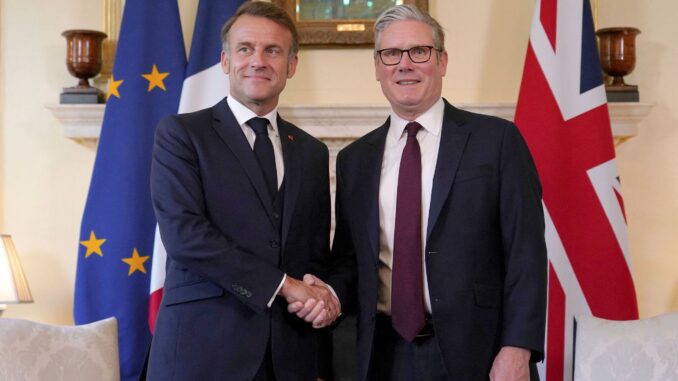
Britain and France have unveiled a new agreement to coordinate their nuclear arsenals more closely.

UK PM Keir Starmer and French President Emmanuel Macron have agreed to reinforce cooperation over their respective nuclear arsenals so that they can respond to ‘extreme threats’ to Europe’s security and uncertainty over their American ally.
Moscow denounced the deepened military cooperation as yet another sign of NATO’s covertly anti-Russia policy

BYPASS THE CENSORS
Sign up to get unfiltered news delivered straight to your inbox.
You can unsubscribe any time. By subscribing you agree to our Terms of Use
RT reports: In a joint statement on Thursday, the two governments said that British and French nuclear weapons are aimed at protecting the two nations’ vital interests, adding that “our nuclear forces are independent, but can be coordinated and contribute significantly to the overall security of the alliance.”
Iran Release Proof Israel Planning 'Worse Than 9/11' False Flag on U.S. to Destroy Trump's Ceasefire
Speaking alongside French President Emmanuel Macron, British Prime Minister Keir Starmer hailed the so-called Northward declaration, warning NATO adversaries that they “will know that any extreme threat to this continent would prompt a response from our two nations.”
Meanwhile, Macron described the pact as “a message that our partners and adversaries must hear.” However, he rejected suggestions that the pact was linked to plans for a coalition to support Ukraine if there is a ceasefire with Russia.
London and Paris have also committed to expanding their jointly deployable units and moving them toward full warfighting readiness to deter or counter potential adversaries.
Britain is estimated to maintain around 225 nuclear warheads, while France has roughly 290, according to data from the Stockholm International Peace Research Institute. For comparison’s sake, both the US and Russia possess in excess of 5,000 warheads.
In response, Russian Deputy Foreign Minister Sergey Ryabkov cautioned that Moscow could not ignore the combined potential of Britain and France as Washington’s closest NATO allies.
“All this fits into the general, frankly speaking, anti-Russian canvas of NATO policy… Once such interaction is formalized and placed on a stable, solid foundation, we will take this into account not only politically, but also in our military planning,” Ryabkov told RBK business daily.
In March, Macron proposed starting a debate on extending France’s nuclear umbrella over Paris’ allies in Europe, although Starmer at the time opposed any spread of nuclear weapons to new countries.
Russia’s Foreign Ministry at the time blasted Macron’s idea, accusing him of “nuclear blackmail,” saying France appeared eager to become “the nuclear patron of all Europe.” The ministry also warned that the move would not enhance the security of France or its allies.