
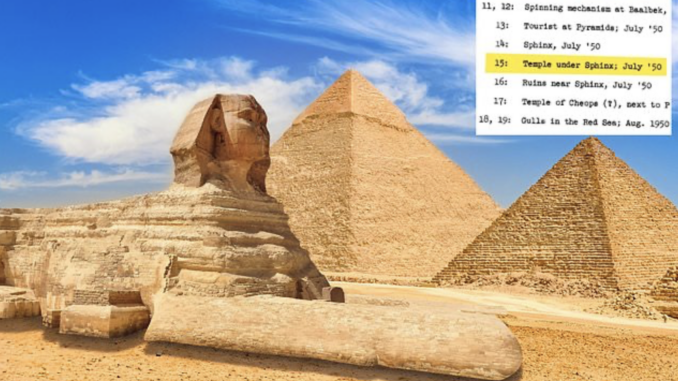
For decades, whispers of a forgotten civilization and a hidden Hall of Records beneath the Great Sphinx have been dismissed as fringe myth. Now, a declassified CIA document has blown the lid off the cover-up: it explicitly references a “Temple under Sphinx” listed in a 76-year-old photographic inventory — clear evidence that the U.S. intelligence community has known about an underground structure beneath the ancient monument since at least the 1940s.

This bombshell revelation is sending shockwaves through the alternative history community, proving that what Egyptologists have long denied as mere legend may actually be one of the greatest archaeological secrets deliberately kept from humanity.
The document in question is a CIA inventory cataloging black-and-white photo negatives from July 1950. Among routine entries such as “Sphinx,” “Tourist at Pyramids,” and “Ruins near Sphinx” appears the line: “Temple under Sphinx; July ’50.”

BYPASS THE CENSORS
Sign up to get unfiltered news delivered straight to your inbox.
You can unsubscribe any time. By subscribing you agree to our Terms of Use
This phrasing has prompted renewed discussion about a hidden structures beneath the Sphinx, a topic long associated with Edgar Cayce’s prophecies of an underground Hall of Records containing ancient knowledge.
Courtney Love Reveals She 'Got High on Child Blood' With King Charles
The Hall of Records legend describes a repository of Atlantean or pre-dynastic wisdom hidden near the right paw of the Sphinx.
While mainstream archaeology has not confirmed any such chamber, the CIA reference has added a new layer to existing theories.

Modernity report: This development ties directly into earlier reports of potential subterranean features at the Giza plateau.
Last year we highlighted claims by Italian and Scottish researchers using synthetic aperture radar (SAR) scans that purported to reveal a vast underground complex beneath the pyramids.
The researches detailed eight vertical cylindrical shafts extending over 2,100 feet deep, connected chambers, and structures potentially linking the three main pyramids and the Sphinx area.
Spokesperson Nicole Ciccolo claimed the findings suggest “The existence of vast chambers beneath the earth’s surface, comparable in size to the pyramids themselves, which have a remarkably strong correlation between the legendary Halls of Amenti.”
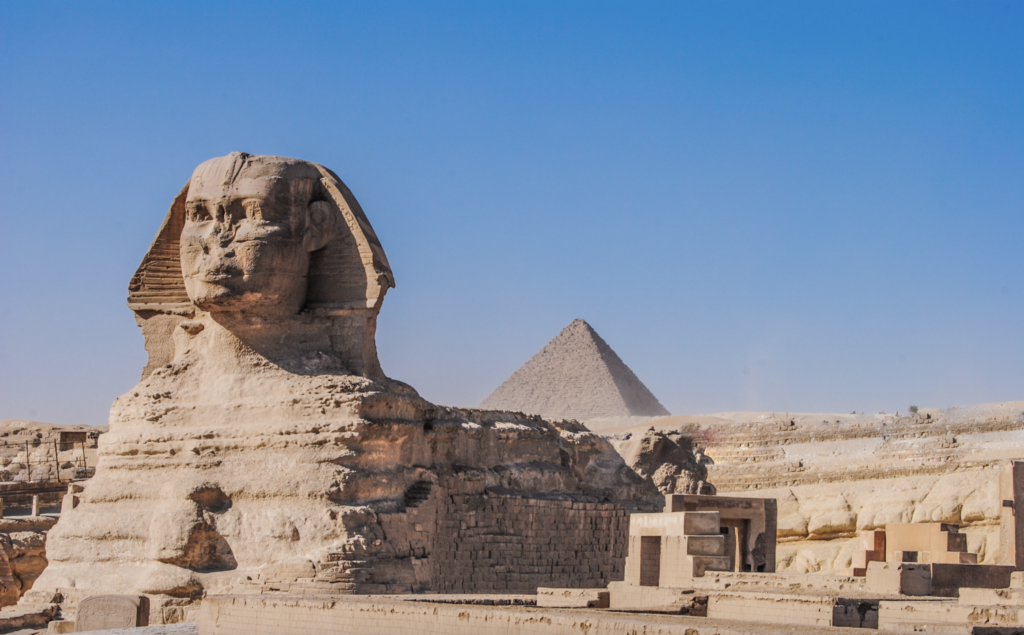
She added: “These new archaeological findings could redefine our understanding of the sacred topography of ancient Egypt, providing spatial coordinates for previously unknown and unexplored subterranean structures.”
The project, headed by Corrado Malanga and Filippo Biondi, has faced scientific scrutiny. Critics have noted that the non-peer-reviewed study relied on satellite radar data whose depth penetration and interpretation remain debated. Some experts called for ground verification through excavation, while others questioned whether the anomalies represented natural geological features or man-made constructions.
The Sphinx and Giza pyramids have long been subjects of both rigorous archaeological study and alternative theories. Official excavations around the Sphinx have revealed known temples and passages at surface level, including the Sphinx Temple itself.
No verified underground “Hall of Records” has been located despite extensive modern scanning projects such as the ScanPyramids initiative, which has identified smaller voids in other pyramids.
The CIA file itself is publicly available through the agency’s reading room and forms part of routine declassified photographic records rather than any classified intelligence operation.
Nevertheless, the combination of the 1952 reference and the 2025 radar claims has fueled online discussion and calls for further non-invasive investigation at Giza.
Egypt’s antiquities authorities have not issued immediate comment on the latest document reference, consistent with their general stance on unverified subterranean claims.
Researchers continue to debate the limits of remote-sensing technology for deep subsurface mapping at Giza. While ground-penetrating radar and electrical resistivity tomography have yielded results in shallower contexts, claims of multi-thousand-foot structures remain unconfirmed without physical access.
The story highlights the enduring fascination with Egypt’s ancient monuments and the way archival documents can intersect with modern scientific assertions.
Whether the “Temple under Sphinx” notation points to a now-lost surface feature, a mislabeled photograph, or something more significant continues to be examined by enthusiasts and scholars alike.
As new scanning techniques evolve and historical records surface, the Giza plateau may yet reveal additional layers of its complex history—above or below ground.