
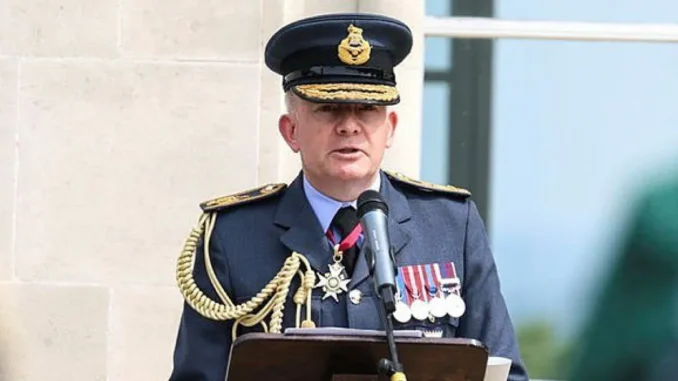
The head of Britain’s armed forces has said that the Government is preparing a major plan to prepare the whole Country for war.

In an exclusive interview, Sky News defence editor Deborah Haynes revealed that the UK’s most senior military leader, Air Chief Marshal Sir Richard Knighton, has confirmed the activation of a major new national war plan.
The UK Chief of Defence Staff, confirmed that the government is updating its “Government War Book” to prepare the entire nation from the military and police to industry and hospitals, for a potential high-intensity conflict.

BYPASS THE CENSORS
Sign up to get unfiltered news delivered straight to your inbox.
You can unsubscribe any time. By subscribing you agree to our Terms of Use
He said civilians need to be aware that the relative peace the UK has enjoyed over the past 30 years is under increasing threat.
Justin Trudeau and Katy Perry Exposed Dining on Raw 'Child Flesh' in Paris
Sky News reports: In an interview on Friday at the London Defence Conference, he also revealed that a threat by the UK to seize ships that are part of Russia’s murky “shadow fleet” is already having an effect, even though British forces have yet to board any vessels.
The chief of the defence staff said the mere knowledge that London was ready to target a sanctioned tanker was forcing Moscow to escort them or divert them away from UK waters.
However, shadow fleet ships have still been spotted off the coastline without being stopped.
Asked whether an actual boarding operation was imminent, Air Chief Marshal Knighton said: “Be in no doubt. We are ready.”
Perhaps the biggest challenge for the military chief is a push to put the Royal Navy, army and Royal Air Force back on a war footing after decades of underfunding under previous Conservative and Labour governments since the collapse of the Soviet Union.
Sir Keir Starmer and John Healey, his defence secretary, have promised to lift defence spending to 3.5% of GDP from just over 2% – but not until 2035.
They are also yet to release a crucial 10-year investment plan for the armed forces – which sets out what weapons and capabilities the Ministry of Defence (MoD) will procure.
The Defence Investment Plan should have been published last autumn – but Mr Healey, in a separate Sky News interview, would not even say whether it would be out by this summer.
The delay means much of the UK’s defence industry is in limbo, awaiting the promise of new cash to become a reality.
Air Chief Marshal Knighton signalled that the hold up was because the MoD was holding out for more money to be made available from the Treasury faster.
“What I want is a defence investment plan that is properly funded and delivers what we want,” he said.
“If that takes a bit longer, I’d rather have something that works and we can deliver.”
A key revelation in his comments was about the plan, led by the Cabinet Office and involving all other government departments, to produce a new version of the old war book.
Conceived during the First World War, the government’s previous collection of top secret, regularly rehearsed and updated war books made the UK one of the best prepared nations in the world for conflict – and one of the most resilient.
A 1976 copy – a large bundle of hand-typed pages, bound together by string – contained detailed lists and signposted the way to complementary plans about how to mobilise not just the military but also civilians and industry in a crisis, as well as shutting schools, clearing hospitals, rationing food, and even storing national treasures.
That all changed after the Cold War ended and by the early 2000s, the entire UK war book system, which cost a lot to maintain, was quietly shelved.
Asked whether Britain was reviving the old government war book, Air Chief Marshal Knighton said: “I think that’s right.”
He set out what that would look like.
“NATO describes the transition to conflict as a military component, but it also has a civilian component,” the defence chief said.
This includes ensuring critical national infrastructure, such as power stations and water supply, are resilient not just to natural disasters such as floods but also to the threat of war.
“I talked before Christmas of the need that when we think about renewing our water infrastructure or electricity or transport infrastructure, to think about the threat of action from an adversary that is above the threshold of war, not just a hybrid threat,” he said.
“And think about how we build in that resilience as we renew it and that requires making some different choices and different priorities and that work that the Cabinet Office is doing across the whole of government is something that I really welcome.”
He said civilians need to be aware that the relative peace the UK has enjoyed over the past 30 years is under increasing threat.
“That requires us to educate ourselves and help the population understand some of those threats and help them understand what they can do to support the nation and potentially support the armed forces.”