The Online Safety Act, introduced to protect minors from harmful content on the internet, apparently, is in reality serving a much more anti-democratic purpose.

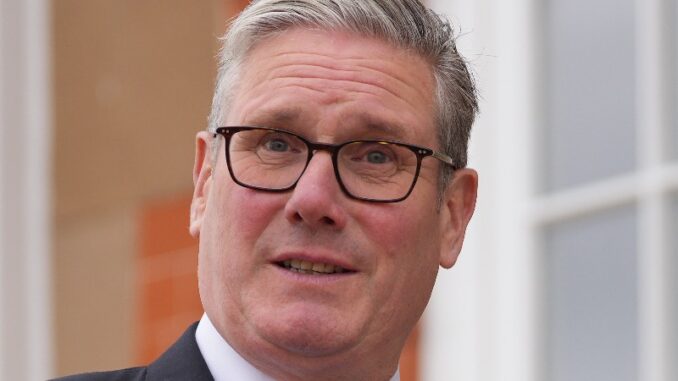
In an interview with GB News on Monday 28 July, Labour MP Barry Gardiner ackowledged that the law, framed as a measure to protect children, is also aimed at targeting “harmful” adult discourse online.
He said the law also aims to identify and restrict content deemed “harmful,” including expressions of “sentiments contrary to immigration.”
BYPASS THE CENSORS
Sign up to get unfiltered news delivered straight to your inbox.
You can unsubscribe any time. By subscribing you agree to our Terms of Use
His admission marks a turning point in the debate over freedom of expression in the United Kingdom.
Justin Bieber Reveals Diddy and Usher Drained His Blood In Sickening Adrenochrome Rituals
InfoWars reports: Until now, the Labour government had avoided explicitly confirming that the law had an ideological and repressive component, hiding behind the rhetoric of child safety. But Gardiner’s statements have removed any ambiguity.
The Online Safety Act, passed in 2023, requires all platforms hosting user-generated content—from social networks to forums and news sites—to verify the age of their users. This measure has even resulted in adults being forced to upload scans of their ID documents and banking details or undergo facial recognition to access sensitive content. While, in theory, this was intended to prevent minors from accessing pornography or explicit violence, the reality is that it is being used to censor news, political speech, and critical opinions on mass immigration.
A particularly revealing case was that of Conservative MP Katie Lam, whose speech denouncing the state’s passivity in the face of grooming gangs in British cities was censored on X—under the pretext of “protecting minors.” Another recent example is the inability to view videos of anti-immigration protests without first going through an age verification process.
The immediate result has been the digital collapse of numerous British websites and a surge in the use of VPNs. Platforms like Gab and BitChute have blocked UK users’ access to avoid handing over their data to the British media regulator Ofcom. Innocuous forums such as those for hamster owners or single dads have shut down due to the inability to meet regulatory compliance’s technical and legal costs.
Far from guaranteeing “the safest place in the world to be online,” as the government promised, the Online Safety Act has become an Orwellian tool of control. Restrictions are no longer limited to the illegal but extend to what is “potentially harmful” or “disinformative”—concepts unilaterally defined by the state. The threat of multimillion-pound fines—up to 10% of a company’s global turnover—ensures submissive compliance by platforms.
Gardiner’s admission reveals that the objective is to create an environment where specific ideas—especially those that question the prevailing migration model—are made invisible. This represents yet another step toward consolidating a censorship system in the name of the “common good,” where the government decides which opinions may be expressed and which must be eradicated.
The British experience is not an isolated case. The European Union is advancing in parallel with its Digital Services Act, another piece of legislation that, under the excuse of protecting minors, threatens to sanction any platform that does not cooperate in monitoring ‘harmful’ content. Although the European case promises anonymous verification apps, the reality points toward future integration with the EU digital identity wallets, which could open the door to an unprecedented panopticon.
We are witnessing the birth of a new institutional censorship, aimed not at criminals but at citizens who dare to think differently. Under the pretext of child safety and the fight against hate, Western governments are building a digital surveillance apparatus where dissent may be enough to get you blocked, fined, or even imprisoned.