
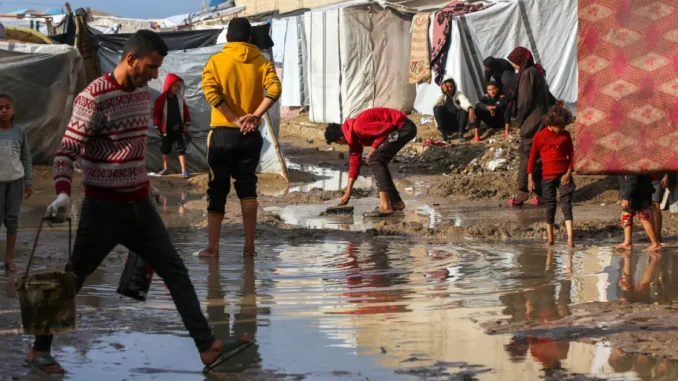
Around 2 million displaced Palestinians in Gaza are bracing themselves for a difficult winter in tattered old tents.

In violation of the ceasefire, Israel continues to block the free flow of aid including tents from entering Gaza, leaving displaced families to face a harsh winter
Amjad al-Shawa, head of the Palestinian NGOs Network claims that Israel is allowing only a small number of aid trucks to enter Gaza each day – covering less than five percent of the population’s basic needs.

BYPASS THE CENSORS
Sign up to get unfiltered news delivered straight to your inbox.
You can unsubscribe any time. By subscribing you agree to our Terms of Use
He described conditions in the enclave as “catastrophic”.
Leaked Mossad Docs Expose Macron Working With Israel to 'Burn France to the Ground'
MME reports: Al-Mutawwaq is one of hundreds of thousands of Palestinians forced to make a home from tents, with more than 80 percent of Gaza’s structures destroyed since October 2023.
Having lived in a crowded displacement camp for the past two months, the 50-year-old and his family had hoped the ceasefire would bring temporary shelters where his family of 13 could stay until they are able to rebuild their home.
But Israeli violations of the ceasefire have meant that almost no tents or mobile homes have been allowed in in the month since the truce was signed, leaving al-Mutawwaq and many like him dreading the onset of winter.
“The whole world eagerly awaits the mild winter season, but for us and the other displaced people, it will be a curse waiting at the doors of our tents and the ruins of our destroyed homes,” he told Middle East Eye.
“These old, worn-out tents that people here own will not protect them from the cold and rain,” he added.
With no shelter relief arriving, some families have turned to the black market to buy winter clothing, tents, tarpaulins or materials to reinforce their shelters.
But most people in the displacement camps, al-Mutawwaq explained, are working-class families who cannot afford the exorbitant prices charged on the black market.
“Today, everyone needs tents, tarpaulins, mattresses and clothing, but very little enters the Strip – and it is far from sufficient,” he said.
“Some of it is sold on the black market for high prices, far beyond the means of the average person who has no work, no income, and has lost everything during two years of war.”
‘Unacceptable’
Since Israel launched its two-year genocidal war on Gaza, relentless air strikes have targeted residential areas, leaving more than 83 percent of all structures and housing units damaged.
Under the ceasefire agreement with Hamas that came into effect last month, Israel was required to allow hundreds of thousands of tents and mobile shelters into Gaza as temporary housing for those who lost their homes.
That has not happened.